Beyond the cataract curtains

You know that feeling when you finally peel aside your dingy thermal window shades and behold the world all around you again? And you wonder if everything was always that bright, or if you’ve just been transported out of your Maine winter mole hole into a vibrant new dimension where the grass really is greener and the yonder the greatest blue ever?

Well, I sure do. I’ve got it major big time right now, and I didn’t even need to wait until May, or whenever almost-spring-but-not-quite-summer arrives back in Rangeley, and I can finally let some full-on sun inside. Because this year, I went way beyond what I could pull off with rolled-up cabin curtains and Windex. I went and got my eyes fixed!

“Didja see that over there?” When folks asked, my default answer was always no…not really. Oh, I’d follow your pointer finger and say “Yeah…wow,” or something moderately convincing till you stopped asking. But what you saw as an eight-pointer or a spike buck or an obviously too tame fake archery target was, for me, just some deer-shaped thing off in the distance. And the bald eagle in my front yard? Well, he had to be soaring pretty low for me to give him the recognition he deserved.

Over the years, I did my best to take full advantage of whatever optometric assistance was available. I got my first pair of glasses, the smallest pair of sparkly blue cat-eye specs, when my third-grade vision test revealed I had the eyesight of a poor little school mouse. After that, each time I couldn’t work my way down the eye chart, I’d work my way up the spectrum of corrective lens technology. I wore contacts back when most people couldn’t imagine how I could “leave something like that” in my eye. I had huge Eighties aviator glasses with so much reflective glass in them that, if I wasn’t careful where I set them down in broad daylight, they were a fire hazard. I graduated to Transitions and Progressives, and whatever other fancy lens labels were in fashion for making me feel better about paying a premium for brown-tinted granny trifocals. Every few years, I’d get a new prescription and a new pair of bright red Zennis…until that just wasn’t enough anymore.

When my eye doctor first diagnosed cataracts, I was surprised. That was something that happened to old people, I said, not me…not yet, anyways. She set aside her little thousand-volt floodlight, met my bleary gaze, and politely replied, “Yes, you.” She said I was right about the “old” part, and wrong about the “not yet” part, because the vast majority of lifelong spectacle-wearing, almost-septuagenarians like me form little dark clouds inside their eyeballs, also known as cataracts. (Turns out teeth and toenails aren’t the only things that get yellow and brittle with age. Your crystalline lenses do, too, but who knew?) However, cataracts are mentioned in the same breath as surgery for good reasons, she said, and I was one of them. Intraocular lens implantation could give me a nearly-perfect shot at nearly-perfect vision. And thanks to all the visionaries making it the safest, most common surgical procedure performed, I had more choices than ever. I could desire an outcome and actually see it come true.

My mother never lived long enough to wear out her eyes. And my father got by after middle age with a pair of readers or, in his case, fly-tyers. So, pretty much everything I knew about cataracts came from older friends who’d suddenly show up barefaced, or trying out new ultra-generic glasses they hoped did the trick, because that one pair was all Medicare paid for after surgery.

“What are your glasses-wearing goals?” the surgeon’s assistant asked during my pre-op evaluation. “How clearly do you expect to see at different distances without them?

“Well, I don’t need to be up there with the yard eagle,” I told her, “but I am tired of being a bat. And I don’t mind wearing reading glasses when I need to, as long as I can find some sparkly red ones.”

“You’re gonna be thrilled with what we can do for you,” she said. It was the first time thrilled—and anybody doing something beyond confirming I needed stronger magnification hooked onto my face—was part of any eye doctor visit. Matter of fact, the only time in 60 years I’d been even moderately elated about the eye doctor was at Halloween when there was a bowl of chocolate eyeball candies out on the check-in desk.

But this wasn’t my regular eye doctor. This, according to their motto, was “Tomorrow’s eyecare today,” a time warp I wanted to enter as soon as I set foot in the one-stop, exclusively all-things-eye-surgery center in Portland. “Best Place to Work in Maine,” the sign in the lobby said, and even though it was still blurry, I knew why. It was the happiest place this side of Disney World, where people like me came to see like they were kids again. Swarms of ’em. “We’re a well-oiled machine,” the staff agreed when I marveled at how efficiently they processed patients. More like a magical metamorphosis machine, I thought, with a steady stream of silver-haired, squinty folks coming in the front like stoic army ants, then out the back with huge “mission accomplished” grins ‘neath their bug-eyed “I just had eye surgery” sunglass shields, to return a week later, barefaced butterflies beholding their new world view.

“After this, it’s gonna be more beautiful than ever for you up in Rangeley,” my intake nurse said when I arrived for surgery. The entire staff knew exactly where I lived, why I needed a different post office address in Oquossoc, and how to pronounce both, which comforted me almost as much as the pre-op IV they promised would make me feel okay about the cutting tools they were about to put in my eye. “Yeah, I’m out on Mooselook,” I told one OR nurse. “Meguntic,” another one chimed in. And I knew I was in really good hands.

Then voilà! There I was, heading back up the mountain the next day, a brand new Clarion Vivity Toric UV intraocular lens, or IOL, implanted in my right eye, looking forward to getting my left eye matched up in two weeks. Until then, I had one good eye on the Technicolor road to Oz, and one bad eye still stuck in dusty ol’ Kansas. But the good eye was so very, very good, I barely noticed. “Wow…look, snow flurries,” Tom said as we came up over the Height of Land. As expected, my right eye felt like Angel Falls at spring break-up. But despite the gritty, gushing waterworks ‘neath my post-surgery sunglass shield, I was able to look. Like never before. And even though Tom had just uttered the “S” and the “F” words so early in November, I saw the loveliest, pearliest, whitest snow flurries dusting the evergreens, the turf browns, the late autumn auburns, and the granite greys all the way down to the bluest blues of my mountain lake home.

“Was it always this blue?” I started asking over and over. I figured I was missing some hue definition and clarity. But I had no idea I’d been blind to an entire spectrum of watercolors, of sky blues, mountaintop blues, and every other shade of Bemis shoreline blue. By the time I got home, I sounded like an oddly upbeat local R&B artist warbling on and on about the bluu-wooo-wooo-a-wooo-ooo’s. Imagine Bob Dylan getting enthusiastically tangled up in them, or Billie Holiday becoming a super happy, albeit off-key, lady singing ’em, and that’d be me.

My world hasn’t been this colorful since I replaced my basic box of school-issued crayons with the biggest box of brand-new Crayolas I could afford with my allowance! And I haven’t seen such an immediate return on any investment since. “Don’t cheap it out, Mom, it’s your eyes,” my daughters advised when I explained my lens replacement options and associated costs for anything above standard. I figured I didn’t need the super spendy, still experimental option for potentially becoming eagle-eyed everywhere all the time. But I didn’t want to settle for the refundable government-issued option either. So, as promised, I stretched my self-worth and out-of-pocket pocketbook a bit beyond standard up toward spectacular, paid for a heaping dose of well-being on top of what Medicare deemed medically necessary, and got my football-shaped, myopic eyeballs fitted with custom, crystal-clear, crystalline IOLs just this side of bionic. For less than what I spend on my mud season vacation, I gave myself a lifelong sightseeing staycation!

Then I spent a whopping $8 on two pairs of shiny red reading glasses I leave around the house, just in case I need to read something smaller than my arm can reach. Yup, the whole not being able to read stuff close up arm maneuver I thought was counter-intuitive, I get it now. Right under my nose no longer automatically equals clearer, and I’ve joined the Where the Heck Are My Reading Glasses Club. At least now I can see far and wide enough to find ’em, though.

“Wow, I always thought that was maroon,” I said the first time I saw my dining room tablecloth through fresh eyes. “It’s really somewhere between garnet and vermillion.” My tropical colors mixed with splashes of reds and shades of provincial blues and greens interior decorating scheme had always been sort of Rangeley meets Key West. But I had no idea I lived in a custom Crayola palette of wild watermelon, atomic tangerine, robin’s egg, shamrock, and all shades in between.

I was experiencing what the cataract crew called the “wow factor”—a kaleidoscopic rush of the highest definition brightest brights and whitest whites in recent memory. My clothes popped, my cabin walls glowed a rich, honey gold, my beloved birch trees stood iridescent. And no more dreaming of a white Christmas, I was living it already in sparkling splendor. But, also wow, was some not-so-shiny stuff I started spotting in my periphery, the darker, dingier side of 20/20 after decades of telling myself my house looked clean enough. Like all the windows I’d pronounced okay this year so I could ride my bike nonstop during optimal fall cleaning days. Wow, was I wrong! Because ya know what else is white besides snow and birch trees? Fingerprints on glass. Last winter’s dust backlit by this winter’s sun. Ashes on cobalt, AKA Rangeley mountain blue, woodstove tiles. Beagle belly fur mixed with cottony balls of Maine coon cat fur. My own fur! Turns out the hair color I saw in the mirror had been a fake shade of cataract blonde, and I was, in fact, an arctic fox. And talk about mirrors! Suddenly seeing myself in all my wintery white-skinned glory as I step out of the shower is definitely a mixed blessing.

It’s been a big adjustment for sure, graduating from worn-out monochrome technology to high-def 4K rez. For a week or so, my brain was recalculating more than a new GPS app with the “avoid dirt roads” option turned on. Thankfully, though, I’m dialed in now, recalibrated, my knack for seeing good in all things hardwired for success. I can look beyond whatever smudge accumulated from another year in my forever home, out at my beloved birch trees and the chickadees I used to think were eye floaters. I can smile barefaced in every mirror, glad to be reflecting back, to see and still be seen, at peace with the antique parts that can be fixed and the steady performance of those that can’t. I can enjoy my best-lit Christmas in years, blessed with the eyes of a child filled with Christmas morning wonder again in the winter of my life. Thanks to tomorrow’s eyecare today, I’ve left dusty ol’ Kansas behind for a new life in balsam-lined Emerald City. And the way I see it, even the dark season out here, also known as the Big Grey Bucket of Suck, is gonna be at least fifty shades better this year, filled with pewter, slate, and plenty of festive field mouse greys.
Springing into cabin cleaning

Spring is in the air and, at last, the sun is peeking out. Finally, you can throw open your windows and exchange a breath of it for the staleness that’s been hanging in your house, along with the ghosts of that corned beef and cabbage you cooked a couple of weeks ago. The birds are singing. You think you might have a lupine or two in the front yard, but you suppress the urge to go and check, knowing you must not withdraw from your domicile and the allegiance it demands. The dust clinging to the window pane in front of you, which has turned your curtains from crisp white to a shade often found on old bread, is as much a harbinger of the season as the robins and the warm breezes. So, you prepare a checklist and steel yourself for spring cleaning. “1. Upstairs: A. Windows and walls; B. Closets; C. Floors…” you write. “2. Downstairs: Ditto, ditto, ditto…” As you’re filling in major categories with more subheadings, you remember last year you had a similar action plan, all nicely detailed on a large sheet of paper, and each time you looked at it you became paralyzed with dread.

You might have turned to self-help websites for a little motivation, where you were met with all manner of training in the science of domestic engineering. Trouble was, you probably spent so much time reading that you were still pecking away at your checklist when your daffodils had given way to tiger lilies. You certainly don’t want that to happen again, so consider this: Our foremothers—who firmly instituted these seasonal scrubbing rituals so that, come warm weather, we’d forget about Gloria Steinem and begin worshiping Donna Reed—called it “spring cleaning” for a reason. Even pre-emancipated wash women intended for a brief respite before fall cleaning, if only to save up their energy for canning and baking all the fruits of the harvest they never got to savor on the vine.

To complete your checklist before you’re dripping sweat into your Spic ‘N Span, you do need to keep in mind some of those nifty tips you read up on last year while procrastinating. The experts would recommend you begin by tackling household focal points first—rooms where family density remains fairly constant over time. Try to view your home as a casual visitor might, drawing your attention to major accumulations of dust, debris, and discoloration. A visitor would see, for example, what happened to the rug when you let the family eat spaghetti in front of the television, not what’s under your bed or in your corners. Adopting this perspective will let you prioritize to get maximum results where it counts. After all, it’s not so much for sanitary reasons that we clean, it’s to give the general impression of sparkle and shine to the viewing public—our company. (They probably won’t be crawling around on their hands and knees or hopping high enough to see most cobwebs. But, if they do, spike their coffee so they won’t care anymore.) It’s important to forget about feels clean and lemony fresh clean, and go for looks clean first. Seeing the immediate outcome of such well-focused housekeeping will motivate you to organize closets and scrub unknown substances from your surfaces later when the fickle Rangeley weather turns lousy again and when you’re not taking an Irish coffee break.

When you’re ready to start tackling your spring cleaning list, an obvious place to start is that kitchen window you just opened—the one your family and friends have been politely ignoring since you put the hibachi right under it late last fall. The experts would agree. It’s small, not time-consuming, and requires few supplies—big pluses when you’re just getting in gear and are easily discouraged. And, once that window’s clean, you can move on to other windows without losing your focus. Begin by gathering your supplies: glass cleaner, paper towels, sponges, and some sort of scraping device for splatters that have no respect for ammonia. If you’re unable to locate your scraper right away, start looking for it in the laundry area first because, that way, you can toss the kitchen curtains in the washer and they’ll be clean when you’re through with the window.

Now, don’t let the fact that your washer and dryer and surrounding shelves have been collecting dust since the 1980s distract you. You’re on a window-washing mission and wiping down appliances would be totally senseless right now. However, since you may never be standing there with paper towels and Windex in hand during this decade, no harm will be done by taking a few swipes at the dirt.

By the time you find your scraper in a closet that demanded total reorganization, you’ll probably be out of paper towels. That’s OK, though, because newspaper—for some undocumented reason—does a better job on windows. If you’re like most Rangeley-ites, you’ll have an ample supply of really old papers to use, even though it’s taken a steady stack to keep the wood stove going since October. And, if you’re like most folks in general, you won’t be able to resist reviewing some of what’s still in the pile. Half an hour later, after re-reading accounts of oil spills, tsunamis, and tornadoes, you’ll naturally be depressed and lethargic. Ten million gallons of black goo floated around Alaska and you can’t even bring yourself to clean a simple window!

At this point, a cup of regular coffee will be just the thing to restart your motor. Do not, however, under any circumstances look closely at your coffee maker while you’re making one! Then you’ll have no choice but to sponge it off, especially up underneath the drip mechanism where it looks like you’ve been brewing with Bemis swamp water. Make yourself sit with your cup of coffee and do your best not to stare at that window you still haven’t cleaned. Lower your eyes, if you have to, to that grungy spot of crud clinging to a juice spill next to the refrigerator. Well, you do have the sponge handy…

When at last you’ve finished your first spring cleaning chore, stand back and admire your accomplishment. The curtains look brand new, except for those grey fingerprints you got on them when your hands were covered with newsprint. You’re exhausted, but you’ve got one-sixteenth of a clean floor, a coffee maker that would impress a contortionist, one organized closet shelf, a washer and dryer gleaming where the sun never shines and, voila, one heck of a spotless window framing the lake and mountains and reminding you, such as it is, why you really want to keep house up here in Rangeley. The sunlight will now stream into your kitchen and straight through your living room, pooling right on that pile of ashes under the wood stove you told yourself back in February you’d “get to”…if it ever got to be spring again.

Dishwasher power control drama

“Hi, my name is Joy, and I have dishwasher control issues.”

That is, I imagine, how I’d come clean to a support group if the opportunity ever arose. Haven’t found a local chapter for this sort of thing yet. But, if and when I do, it’ll probably be in Farmington or further down the mountain, well worth the gas money to find enough dishwasher density per square mile, and the like-minded souls standing sentinel by them. Meanwhile, though, I must rely on my internal psychoanalyst for help.

“Let’s think back on how this issue began to manifest,” she says calmly. “When did you first notice your behavior changing? When did your reaction to your dishwasher start becoming a controlling influence on your day-to-day life?”

I call her Amy, short for Amygdala, as in brain cortex emotional response amygdala, because I rely on her to keep that tiny center of my reptilian brain from transmuting into the Creature from the Black Lagoon. She is serene, soothing, rational, professional but still approachable, and just a tad pushy—my voice of gentle authority and reason. She’s always on call whenever I need her, showing up in her sensible work lady shoes and layer upon layer of “casual Friday” fleece, pen poised over notepad, ready to record, underline, and asterisk as necessary, and, ultimately, organize my situation into an actionable, bulleted list. I’ve never seen her living situation, so I can only guess how she applies all her therapy cred to her outside-the-office self, but I imagine she has no problems nerding out over her dishwasher or with any other appliance fixation detracting from her perfect work-life balance.

But, as Amy herself always says, such assumptive comparisons only detract from figuring out how to live my best life in all its imperfect splendor. “Every soul has dirty laundry. And dirty dishes,” she reminds me, her tone somewhere on the tough love side of touchy-feely. “It’s what you choose to do with your pile, how you respond, that creates harmony…or turmoil.”

I first noticed I might have a problem sometime in my early thirties. Before that, back when my first dishwasher was the size of a trash compactor, I was fine. Operated with one knob, its only custom option being a magnetic faceplate I slapped on to make it match my harvest gold kitchen, I barely gave it a second thought. But later, as my Corelle place settings grew with my family food prep obligations—and the possibilities in my local Sears showroom progressed, seemingly, into Jane Jetson territory—so did the complexities of my absorption. Did I need to upgrade to the model with the control panel that looked like it was designed for the space shuttle command center? Should I do like the TV commercial and cram everything in there and run it every night just to make sure my favorite spatula and fry pan were always at the ready? Or should I implement a just-in-time, hybrid construct based on my low level of aversion to washing things almost as big as the sink right there in the sink? Eventually, I adopted a sink-plus-dishwasher-when-needed approach. But, for whatever reasons, I decided the “when needed” part needed to be calculated and monitored according to a rigorous, but allusive, set of standards. My standards.

“It was almost full, so I just let it run,” I remember Tom saying when I came home one Saturday to the unmistakable sloshing, pumping, and swirling of my dishwasher in mid-cycle.

“How?…Why?” I muttered, not yet able to recognize, never mind admit, feeling any type of way about the situation. I’d only been gone a few hours, long enough for him to dirty one, maybe two, lunch plates and, perhaps, a fork or two. And last I’d looked, there’d been enough viable space in there to handle dinner and, best case, breakfast tomorrow! I bent down, putting one ear closer and, sure enough, the surging already underway in there was suspiciously vacuous, definitely not the sound of sudsy water sluicing over strategic formations of tightly packed dishes.

I yanked the door open mid-slosh, flung my fogged-up glasses on the counter, and craned my furrowed, steamy brow inside as the spray arms rattled to a stop above gaping holes in proper, practical placement. Each rack was like a hollowed-out version of a honeycomb I should never have deserted.

“You call this full?” I challenged, pointing at all the available nooks and crannies, mentally retrofitting a cereal bowl here, a mug there, until I could deem it really, truly, 100 percent loaded. A warm, clean cloud of vindication mixed with a twinge of gratification I didn’t yet fully understand seeped under my skin. And even the beep, beep, beeping of an interrupted wash cycle could not dog-whistle me away from digging in and standing my ground—until later that night when it was, in fact, actually, unmistakably full and I’d proclaimed it so with exaggerated hand gestures and loud, snarky comments. Like if a Price Is Right girl with too much attitude got recast onto an episode of My Strange Addiction, that was me.

“Well…that wasn’t really skillful,” Amy said after I’d calmed down a bit. “Does it really matter if you save a bit in electricity and soap at the expense of people’s feelings? Let’s get you to a place where you’re okay with allowing him to help with the dishwasher, even if it isn’t perfect. Next time, let’s take a step back and remember RAIN.”

Amy likes to remind me about RAIN, not the April showers or the Clapton love song kind, but the Zen wordplay kind that’s supposed to empower me to reign in my crap and focus on self-cleansing. When I feel the queen bee in me emerging to hover over the dishwasher, I gotta hang loose long enough to Recognize, Allow, Investigate, and Nurture what the heck is happening…and why.

“Yeah, I see you, my winged alter ego, making a beeline for the dishwasher. I recognize what you’re all about,” I gotta say. Then I gotta allow the experience to “just be” without judgment and/or drowning it out with worse, unskillful choices until I can investigate it down to its tangled roots and, ultimately, nurture my way toward calm compassion. It’s taken years, but I am getting better at the recognition and detachment-enabling parts of that process. And when I do get triggered and can’t manage to just walk away, I know how to engage in quiet, covert dish reappropriation exercises that are self-soothing and non-toxic. So I guess you could say I’ve moved on to mastering the investigative self-acceptance half of the equation and I’m on the lifelong learning track.

When it comes to investigative introspection, I’m writing the book on How Did I Get the Way I Am?. It’s a self-help autobiographical work-in-progress mystery with so many side annotations that my pre-digital Dark Ages newspaper editors would call it “messy copy”, and my online software support editors would deem it pre-beta, “for internal use only.” Especially the How Did I Get the Way I Am With Dishwashers? chapter. That one’s under constant revision, but I’ve rough-drafted a few hypotheses.

A lot of it, of course, boils down to the ol’ nature versus parental nurture premise. How does the way I naturally came into the world, combined with how I was or wasn’t nurtured, affect my conduct around dishwashers? Well, for starters, my nickname is Fidget. As in the proper noun form of “moving around restlessly, nervously, or impatiently.” Tom gave it to me soon after our first date, back when Dingbat and Meathead were household names and Fidget sounded relatively cute and unabrasive. Most days, he still keeps his tone affectionate when he says “Don’t freak out, Fidget, I ran a load of dishes for you.” Kinda like when Jamie in Outlander tells Claire “Dinnae fash yerself, Sassenach,” and manages to calm her down. I wonder, though, if it wasn’t the 18th century and Claire had to watch Jamie heedlessly loading a dishwasher, whether she mighta just fashed herself back through the stones. Hard to know. Meanwhile, I’m glad my real-life husband stifles his Archie Bunker eye rolls when I go dingbatty over the dirty dishes.

So, yeah, there is a fair share of figetation factored into my basic personality, skewing my domestic composure and balance. I’m not your classic neat freak, though. I believe a little bit of clutter has character, that out of sight is definitely out of mind, and clean enough means never going after anything with a Q-tip, an old toothbrush, or any sort of freakish Swiffer arm extension. My housekeeping style is more about sanity than true sanitation, about the pure, fresh comfort I find in the illusion of having control over my surroundings. It manifests in Mug Shui (what my family calls the favorites-first preference with which I select my daily coffee mugs from the cupboard), my penchant for outward-facing can labels (born from my first apartment where no cupboards meant Campbells and the Jolly Green Giant became colorful kitchen accents), and my unshakeable belief that omnipresent police monitor whether or not my bed is made. And by jeezum, doesn’t my figetation favor the dishwasher!

But, why, specifically, do I laser in on my GE PowerQuietPlus and not my other appliances? Well, like I said, I have some rough theories. One of my favorite Christmas memories was my mother getting her first dishwasher back in the mid-Sixites. My father led her blindfolded out to the garage to behold the miracle of emancipation lying within the giant Sears box. Built-in under the sink wasn’t a thing yet, but Mum was so tickled to be away from the sink that she happily wheeled it over to the faucet and back again. I also remember coming of age during the 1970s energy crisis when, suddenly, “running everything all at once” like a dishwasher and/or lights and a refrigerator made the electic meter on the side of the house churn through dollars like nobody’s business. Back then, nothing was digital or smart about the meter. It was a GE glass-domed gizmo with a perpetual motion horizontal wheel that looked like a mini circular saw buzzing through your kilowatt hours, rapid-fire flipping the black and white numbers display that, come the end of each month, added up to an electric bill that would send shock waves and vows of reform throughout the family. Sometimes I’d find my dad outside peering at the damn thing while it whirred away like a demonic hamster was stuck in it. He’d do the old guy pocket change jingling thing, wishing he could somehow put a couple quarters in there and take some of the sting out. That was right about the time he started blow dryer shaming me into not wanting to come home from college. “Why do you need electricity for your hair?” he’d yell up to the bathroom, suggesting I leave a couple quarters beside the vanity to pay for my vanity. Needless to say, the dishwasher only got powered up when we were down to our last plate and fork.

Eventually, we all calmed back down, but not before I’d made the neural connection that automatic dish cleaning was an indulgence to be approached with reverence and moderation. I got married, got my first house, and graduated up from apartment-sized to family-sized models of my own. Very slowly and methodically, of course, until I made The Big Move to Rangeley to live out my “last (fill in the blank appliance) I might ever need to buy” years in my used-to-be camp cabin.

“You’ve got a dishwasher and a dryyyyyer? At camp?” my mother-in-law said the first time she saw my retrofitted, renovated kitchen. She had this way of overly emphasizing the word dryer so her lips recoiled along with the rest of her, dragging it out to rhyme with “why.” As in “Why does my daughter-in-law need a dryer when there’s perfectly good free air all around her?” To her, energy crisis meant having more than one thing plugged in and, heaven forbid, operating at once. And vacations, she’d remind me, meant “a sink with a better view” and no hot running water. Having evolved along that same path myself—with memories of bathing my babies in a Rubbermaid Roughneck tub filled from the lake, and the unbridled joy of any water finally flowing out of a faucet still pretty fresh—I thought I’d paid my dues, too. But in the eyes of the powerwashing while penny pinching pioneers of the previous generation, I was a bit spoiled. Not Kardashian spoiled, kilowatt-hour spoiled. Because I was upta camp racking up the kilowatt hours like they were S&H green stamps I couldn’t redeem for stuff I really needed.

I’m in a good place now, though, a place of self-nurturing and affirmation where I can honor my legacy and see my dishwasher for exactly what it is: an acceptable extravagance. Fifteen years later, the blush of newness might have worn off the ol’ GEQuietPowerPlus, but it still lives up to its name. Twice a week, of course…no need to go off the rails just because I can. And I think I’m getting my control issues under control. When I feel at all triggered, I admit that, yup, I am a retired technical writer who used to thrive off reordering the messiest, most scrambled engineering puzzles into tidy little procedures. I cut myself some slack when I don’t know what day it is (name or number), but I can tell you, based on a fine-tuned calculation of available slots and crevices, the precise moment my next dish cycle should start. I even kept my world from tilting off its axis during a tough transition to phosphate-free detergent, serenely shifting from my Great Value value-sized bottle of liquid to those teeny tri-colored packets. What, exactly, goes on with those tiny little cubes? Whatever is it, it’s beyond any time-released, super-concentrated phenomenon I’ve ever had to figure out. So, for the most part, I’ve stopped trying.

“The dishwasher doesn’t care,” Amy reminds me if I start to wonder too zealously. “The dishwasher can’t make you feel anchored and validated. You make yourself feel that way by what you tell yourself when you load and unload it.” That helps quiet the back-to-front, top-to-bottom, mug shui first-in-first-out dialogue in my head that’s ever scheming to outsmart my CMP “smart” meter at all costs. For now, anyways. And, on occasion, I’ve also managed to relinquish dishwashing control to Tom and he’s done fine. Just fine. I can even have calm, detached conversations about what used to send me into a tizzy.

“Have you seen what you can do with these new dishwashers?” my girlfriend asked the other day. She was showing off her WhirlpoolTurboTech 9000, and she was in my kitchen, nowhere near hers. “I can auto-start it from this app, monitor its wash and dry time, select speed booster or energy-saving express mode, plus all these other features I haven’t figured out yet, and I can control everything remotely. Home Depot is having a huge sale right now. Sure would make a nice Christmas present if you need an upgrade.”

I leaned away from her phone, drank my coffee from my Tuesday cup, and smiled. “I’m good,” I said, “All set for now.” And I think Amy agreed.

Fresh amazement

Forgetting is not necessarily a bad thing. I mean, forgetting things like when my out-of-town guests are showing up or where my next turn is in one-way city traffic can be problematic. But temporarily forgetting how far I’ve come and what it has taken for me to get here? That’s fine. As long as I remember to remember. Because when I do, and do it right, it’s a special kind of magic. It’s fresh amazement.

Fresh amazement. Sure sounds good, right? And you know what? It feels even better, way better than worrying whether I’m just a dunderhead.

I’ve been thinking a lot about my thinking. Or, as Nana used to say, “lack thereof.” Unlike poor Nana, I’m not wrapping up empty boxes with Christmas paper or waiting for the streetcar to take me back to Malden. And I’m glad to report that I aced my annual wellness exam brain teaser like a trooper. “Apple, monkey, table!” I proudly parroted back at the nurse—–proof I can retain random words while doodling a clock face with big and little hands in the right places, then walk across the room, and touch my toes—–and, therefore, am not currently exhibiting cognitive shortcomings, hereditary or otherwise. So no worries about drawing a complete blank or going Nana flakey anytime soon, which left me not so much questioning my brain’s working capacity as I was its working order. As in why, with so many mundane details in there front and center, do I have to try so hard to keep hauling the monumental ones out of the archives?

Why do I need constant reminders of hard-won progress? How is it that I can readily recall what I wore, said, ate, and sang along to on any particular day way back when, but need sticky notes and other props to keep the big stuff from falling through my cranial cracks? What’s the point of forgetting how good it feels to feel really good, then remembering, only to forget again?

These were the questions seeding the early stage of Rooted In Rangeley story germination—-where I don’t know what I’m trying to say but I do know there’s something potentially profound planting itself in the ethereal mumbo jumbo of my inner ramblings. Something New Age-y that still made good sense. Something both thought and laughter provoking. Something may be of value to others beyond myself.

Searching for answers, I took a psychoanalytical deep dive into reasons why the human brain, mine in particular, keeps handy what it needs for any given moment and stores the rest for retrieval and reuse. I read about recency bias, adaptive forgetting, and other innate tricks it uses to keep me safe, sane, and not whirling out of control like some backwoods R2-D2. Nothing really struck me, though, until I came across this pearly nugget: “Of course you can’t remember everything, every feeling you had about every single day. If you did, you’d spend each waking moment in an endless cycle of reliving the past with no focus or scope for the present. You’d have no relativity, no room for retrospection, no reawakened emotions. What fun would that be? You’d have no fresh amazement.”

Bingo! There it was. Amid my Psychology Today meets the Tao Te Ching search for share-worthy stuff, a nifty little word combo so spot-on it took whatever the heck I was aiming for and nailed it perfectly. Fresh amazement.

Fresh amazement is the upside to temporarily forgetting past hurdles to throw my energy at new ones. It’s why it’s OK, I’ve decided, to keep glancing over my shoulder and shoot for the next brightest spot on the horizon as soon as I emerge from the shadows. It’s a fleeting state of renewed awe and appreciation, a glass-half-full zone worth every prompt and reminder it takes for me to always return there. And lately, it’s why I have an unused pair of walking canes hanging up in my home like prized 3-D art curios.

“Sayonara, suckers!” I told the clunky “assistive device” canes, super stoked to be swapping them out for a new pair of sleek, portable hiking poles. But instead of putting the rehab grade, tripod-tipped set back under the bed or up in the attic, I left them hanging out in plain view. Because while I might not need to use the old poles, I very much need to see them. Every day. As I’m grabbing my “everyday” ones and heading out and around. As I’m remembering to feel fresh amazement with every step.

When I retired the ol’ clunkers earlier this summer, I promised myself—-for the second time in a row—-if I was able to walk again “like normal” I’d never ever take it for granted. Like normal, you see, means getting where I want to go using one, sometimes two, walking sticks with occasional, sometimes epic, trips along the way if I don’t pick my feet up and start shuffling. In my case, it means powering through being born with mild cerebral palsy, then growing old with whatever wear and tear gets factored in along the way. It means finding balance, literally, between allowing myself to atrophy and pushing myself to exhaustion and more injury. Most importantly, it means remembering to pat myself on the back when it feels easier to just badger myself.

And that last part, the remembering the right way part, is almost as hard as putting one foot solidly in front of the other. “Remember when you could do power aerobics or ride a regular mountain bike in skimpy Spandex and high-top Reeboks? That was awesome!” I’m apt to tell myself with Chris Farley wistfulness and a vision of my 30-year-old self prancing around in my head. But that never leads to a good place. Reminiscing about my all-time personal best as I’m slipping into my comfy workout/wind pants and Dr. Comfort sneakers to go for an e-trike ride or a slow but steady walkabout does not bring fresh amazement but, actually, quite the opposite. I can get stuck in a state of stale indifference or, worse, rotten dejection. That’s when I need to bring my comparisons into the not-so-distant past, away from the leanest, sturdiest, most badass me, back to the still going pretty strong at almost 70 me—-who’s way better than she has been recently. That’s when I re-amaze myself. And that’s where props come in handy.

One long, mindful look at my clunker canes hanging by the door—-or at the empty corners of every room where I used to park Rosie (my bright red, all-terrain rolling walker)—and I recall just how badly I needed them and how desperately I had to muckle on, afraid I was getting closer to a wheelchair with each step. I remember the sadness of having my legs betraying me, of my mind losing control over my muscles, the pain in my old, achy hip, and my tired, bewildered spirit, the relief of finally getting the right kind of professional help, and daring to believe I might get better. I can see myself walking out of Maine Medical with a brand new Wonder Woman hip and, more recently, learning how to walk again after a nasty drug—-meant to calm my restless legs at night—-backfired, turning me into an anxious, clumsy rag doll unable to do so on my own. I feel myself recovering, twice in a row, and the superhuman sensations of the pain subsiding, the struggle easing—-of picking my head up, planting both feet, and getting back to being my old self.

I didn’t have such poetic words for it at the time but, man, when I was able to get back down to my lakefront without Rosie or the clunkers, using just my own steam and my everyday hiking poles, that was a whole new level of awesome! Has been ever since. As long as I watch my feet and the sleek red poles keeping ’em steady—and I remember to remember when that didn’t seem possible—my focus realigns and my path opens as wide as the Big Lake in my front yard the first time I took it all in again.

“Watch where your feet are going,” I’ve been told my whole life, advice I’d never thought I could put to positive use. Mostly because it came right after I stumbled and, often, right before I walked into a tree or a wall trying to watch where my feet are going. So it wasn’t the sort of advice that made me feel newly marvelous. But now that I’ve watched my feet and legs come close to going nowhere without a lot of help, I’ve found the right context, the right way to remind myself to watch, compare, and realize that this and all blessings are fleeting. I feel joy in every moment of moving forward in my own special way. I feel fresh amazement.

And while walking wonder is such a go-to source, being right in front of me and all, it turns out that fresh amazement is, actually, all around me. I just have to keep my mind and eyes open, keep finding my own answers to the old question: Don’t it always seem to go that you don’t know what you got till it’s gone? Yes. But if you’re lucky you get some of it back and, when you do, you know enough to hang on to it hard because it could be gone again in a second. There’s no app for that, no customizable pop-up to spark that kind of mental clarity. That’s OK, though, I never have to look too far for more prompters.

“Wow, remember COVID,” I say to myself every time I see the stack of masks, unused test kits, and the tiny, go-anywhere clip-on bottles of hand sanitizer in the corner of my cupboard. “Remember how wonderful it felt when you stashed this stuff away because you were able to start going places again without being scared you might die?” Yup, sure do. And if that doesn’t fill me with fresh amazement, there’s plenty of other cues close-by: All the half-full bottles of awful prescriptions I’ve stopped taking for good. The pile of bigger girl pants gathering dust. The ancient dog bed where our fifth “best beagle ever” sleeps by my side. The useful space on my countertop, in my fridge, and in my life, now that I’ve given up drinking once and for all. The luggage I’m happy to unpack when I return to my home sweet home that stays right where I can grab it for my next adventure. And then there’s always the calendar, and the yin-yang Rangeley weather to stir my awe and appreciation.

“I’m gonna really try to remember this in January,” I said the other day as I basked in the balmy, bright, calm, bugless September air. Moments earlier, I’d been wondering why I couldn’t have weather like that in July and August, how long it would last, why the leaves seemed to be piling up on the deck faster than usual, and blah, blah, blah. Then one of those “this was how things were for you a year ago” type of Facebook flashbacks came on my screen, showing a sleet-covered path down to my grey lake, and me out there in my Elmer Fudd hat and serious jacket already. Outside my real window screen, however, summer was still waiting in all its fleeting glory. So I grabbed my poles, smiled at the ol’ clunker canes on my way out the door, and savored the fresh amazement.

Weather…or NOT!

I’m not sure who the audience is supposed to be for most National Weather Service “special advisories” in my area. Especially this one from last June, typical for the time of year when temps start creeping up like we might actually be rounding the corner from not still spring toward maybe a stretch of summer soon:

Special Weather Statement for Northern Franklin County (June 15): The warm air temperatures this weekend in the 70s and lower 80s may cause people to underestimate the dangers of the cold water temperatures, which are currently only in the mid 50s. The cold water temperatures can quickly cause hypothermia to anyone immersed in the water when the water temperature is below 60 degrees. The average submerged person could lose dexterity within minutes and be unable to accomplish simple tasks. Anyone on small boats, canoes, or kayaks should plan accordingly if recreating this weekend and use extreme caution to avoid this threat.

It was the real deal, dominating the online weather forecast with so many capital letters and exclamatory symbols it might as well have been an all-points bulletin about a serial killer on the loose or an SOS to all ships at sea.

“Seriously?” I said. Sitting there in my shorts, all-season fleece jacket and slipper socks, I got the feeling that whomever the national weather authorities thought they needed to alert, they weren’t from around here.

As a seasoned Rangeley resident, I know that May typically translates to “May I please put away my hat and gloves a few days before my Memorial Day cookout?” Then comes June-uary when, even if I get a few of those almost-summer teaser days, I’m not gonna dig out my bathing suit anytime soon. And I’m certainly not gonna go and immerse myself yet. Not intentionally, anyways.

Coming up to Rangeley and places like it as a kid, I used to intentionally immerse myself in the lake as soon after ice-out as possible. I didn’t have AccuWeather radar or emergency bulletins to warn me not to “underestimate the danger.” I didn’t even have the sense that God gave geese, or so I was told. But I had my Dad, standing on the dock as I cannon balled past him, hollering something about being a numb skull and going into cardiac arrest. I could barely hear him, though, with the cold, cold water closing over me, making my heart nearly stop and my head go numb.

It didn’t take too many summers for me to realize why waders and wet suits were popular things. And why my parents waited for those rare 90-degree days to do the Mom and Dad swim-shuffle up to their waists and back to shore. Not because they were old. Because they were wise.

Before my Big Move to Rangeley, I used to pay pretty good attention to weather advisories. That’s because doing so could grant me official National Weather Service permission to “work at home” instead of slip-sliding down the turnpike to spend eight hours in an office cubicle. It could also clue me in to an ensuing snow day. That way, I’d keep one eye open the next morning for the best weather-related “news you can use” in a house with teenagers and a teacher husbandthe list of school closures. When our town finally scrolled across the TV screen, I’d authoritatively announce that they could all stay in bed and then I’d shuffle back there myself.

Out here year-round now, I barely bat an eye. Seeing a generic weather “statement” is kinda like when I’m sliding into a 180 in the Subaru and the little red squiggly icon flashes on the dash to tell me, officially, that my road surface is frozen and I need to exercise caution. Ya think? Geez, so glad I got that super helpful validation so I wouldn’t be befuddled and skidding toward a snowbank at the same time!

Who needs to click on the little red exclamation banner across the online Rangeley forecast to read the painfully obvious? Not me. Something about having snow piled past your window sills imparts an innate sense of knowing. Nor’easter coming? Got it. Freezing rain turning to snow to rain then back again? Been there, doin’ that. Even on the days I try to ignore what’s all around me, a few steps off the back porch keeps me up to the minute on current conditions in my area.

Yup, after fourteen winters and almost-summers on the Big Lake, I instinctively already know. Or if I don’tpromptly and preciselyI act as if I do. Meaning I assume I’m gonna need a Gore-Tex coat, a few layers of fleece, socks up to my knees, waterproof gloves, all-terrain footwear, three different hats, zip-away pants, an umbrella, a shovel, a couple flares and a cell phone, even if the only coverage I might get is with the flashlight app.

Try as they might to encapsulate my local weather into a one or two-line forecast, the nerds at the National Oceanic and Atmospheric Administration, or NOAA, hardly ever hit it right. That’s becauseto borrow an analogy from my software development tech writing daysit’s like nailing Jell-O to a tree. There are just too many ever-changing variables to squish into a blanket statement. Mountain currents, lake effects, you name it. Efforts at articulation usually end up with too little too late or somewhere in La La Land.

It’s still a fun guessing game, though, logging on to look, getting the meteorological low-down on what I can see coming across Bemis from town, or what the really big Great Lakes are supposedly sending my way. Then I concur with Tom, my resident Charlie Lopresti, and try to plan accordingly. Most days, it goes something like this.

Me: What’s NOAA saying about today’s weather and the possibility of outside activities?

Tom (on his NOAA-defaulted laptop): It’s fine if you don’t mind getting wet.

Amend wet with frost bitten, wind blown, dusty and/or burnt, and we pretty much have a custom, regional AccuWeather forecast. Most days, it’s good for whether or not we decide to head out, hang back, stock the pantry, or stoke the woodstove. Except for that really, REALLY wet stretch back in December, when sure ‘nough the creek did rise, taking us by surprise, and our bridges and all land access in and outta here along with it.

“Forget about NOAA,” I told Tom as we sat in the truck on the stranded side of what used to be the Bemis causeway bridge. “We need Noah…the guy with the big, biblical rescue boat!”

Two-thirds up the line

My biggest guiding principle in life did not come from school, church, or the sanctuary of my Adirondack chair. It came from an appliance store.

And not a Home Depot or Lowe’s—where limitless possibilities of appliances stretch on beyond the do-it-yourself aisles in their own galaxy of stainless steel—but from a small-town showroom.

It all began with a compact washing machine from Sears. I was newly-married and living in the attic apartment of an old Victorian house turned medical building my friends nicknamed The Hobbit Hole. Perched in the eaves above a dentist office waiting room we had to weave past on our way upstairs, our little love nest had quirks, and one major perk: Rent was $25 a week, all utilities included. And, it was right next door to Sears, issuer of my first credit card. This was back when Sears thought women couldn’t be held responsible for their purchases until they had a husband so, according to the card, I was Mrs. Thomas Clough. But, as such, I had enough laundry to decide that the Lilliputian-sized washing machine on wheels with its screw-on faucet hose was way better than trips to the laundromat. And for $25 a week, I could push that sucker over to my kitchen sink, plug it in, and let it use as much hot water and electricity as its dinky little agitator drum could handle.

So in I marched, to the far left of the short line of Kenmores, to the special display space reserved for the smallest budgets and living spaces. There was one compact washing machine in stock and, even though I’d admired it from the window and knew I was already sold, I lifted up the lid and walked around it a few times to seem like a savvy consumer.

“You guys deliver, right?” I asked the Sears salesman as I dug out my credit card. “I’m right next door.”

The next day, patients sitting on the bench outside the dentist office had to curl back their toes and scooch their legs 90 degrees sideways to make room for my first new appliance on its way through the narrow waiting room and up the spiral stairs to The Hobbit Hole. I hoped they weren’t the same patients who, a year or so later, had to repeat the maneuver for my second new appliance: a portable dish washer. Not much bigger than a file cabinet, it had one knob and an optional magnetic face plate that changed it from white into a contemporary avocado-colored appliance. And, when I wheeled it in the corner opposite the washing machine, it doubled as a typewriter stand.

Both machines served well beyond their move out of The Hobbit Hole—past a bench full of patients I hoped had not previously swiveled sideways for my appliances—to our first house. The avocado dishwasher joined my second-hand copper-colored stove and harvest gold refrigerator in my new kitchen where they perfectly matched my vinyl floor. (Yes, in 1979, Congoleum actually sold a pattern with all those colors, enabling me to complete my “psychedelic autumn explosion” decorating scheme.) For a while, my hodgepodge remained functional and stylish—and I remained blissfully outside of the appliance showroom.

“There’s more for your life at Sears!” When I had to start venturing in again, that’s what the new slogan promised. But that’s not what finally drew me back. Dire necessity and the lack of big box store options did. I didn’t need more for my life—not until I replaced my refrigerator that just crapped out in the middle of July, my washing machine that was agitating my nerves instead of my clothes, or my dead dishwasher. And I didn’t need Consumer Reports or much brand knowledge—except that I wanted brand spanking new, and I wanted it now. So I did what any young, blonde woman with a Mrs-something credit card would do back in the days before Google and political correctness. I asked the Sears sales guy for advice. (Yes, in the days of Mrs-something credit cards, saleswomen never made it out from behind the catalog desk far enough to help with appliances, so it was always a guy.)

I’d do a semi-confident domestic goddess stride past the showroom lineup of whatever appliance I suddenly needed—lifting lids, fingering controls, trying to look fussy. Then I’d cave. “If you were buying one of these, which one would you pick?” Invariably, the sales guy would meet me about halfway up the line—past the bare minimum models on the far left, but before the ultra trendy models closest to the store window on the right. “You don’t need a lot of that stuff,” he’d agree, pointing toward the high-end. “Unless you have a huge family, entertain a lot, or want the thing to practically run itself, then you’re better off going with something like this.”

And “something like this” was usually spot on, the best bang for my buck. Middle of the road plus a tad extra. A dishwasher without a control panel designed after the space shuttle command center, but with more than one knob and an on-off switch. A stove that was better than a grown-up girl-sized EZ Bake Oven, but not jacked up with too much Martha Stewart sophistication, either.

By the time I was creeping up on middle age, aiming a few stars up from mediocre had gone from a purchase plan into a full-blown philosophy, a lifetime maintenance policy born of Yankee frugality and the blessed wherewithal to do something special with what I’d inherited and earned. I’d figured out how to apply the two-thirds yardstick to pretty much everything in my career and my leisure. I knew when to slow down a wild sprint, how to go from super-sizing to skimping and back again as needed. Somewhere between what my mother would call “hoity-toity” and “ticky-tacky”—that’s about where I wanted to end up.

And now that I’m two-thirds up the line of my life’s journey, I’m doing better than ever at holding that sweet spot—physically, mentally, and financially. “It ain’t the Ritz, but it sure ain’t the Motel 6, either,” Tom and I say these days as we settle into our vacation destinations. We have enough Rent-a-Wreck memories to keep our sights this side of ultra el cheap-o, and enough savings and foresight to know we can splurge on what we really want to remember when our travels are done. So whether it’s our mud season home away from home or a bucket list excursion, I scroll about two-thirds down the booking site, and away we go. Then we come back to our little cabin and, within reason and good sense, finagle every last ounce of usefulness out of the things we’ve come to call necessities.

Like our 15-year-old stove. Or “range” as they call ’em nowadays—as in price range, meaning a price range this side of four figures only gets you a notch above one on the side of the road with a “still works” sign taped to it. When my newfangled glass cooktop cracked in one corner recently, I was glad my appliances-paralleling-life analogy was more philosophical than literal. “Good thing I don’t have to be thrown in the scrap heap now just because I have some surface cracks,” I said when I found out you can’t do a facelift on a Jenn-Air downdraft drop-in range unless you want to shell out more money than poor Jenny’s worth. So sensibility and the risk of electrocution won out over the argument that old Jenny was still 80% serviceable, and I went into market research mode again. Online this time, filtering by function rather than my usual default of cheapest ones first, I found a four-star range that fit right into my “not just camp anymore” kitchen. It’s Bluetooth-enabled so, supposedly, I can give it cooking instructions from another room if I ever decide to stop doing that to my husband.

This could be the start of the “last one of those I’ll ever buy” phase of life. If so, I plan to slide into it gracefully, pointing my compass a few degrees north of moderation and mediocrity as long as possible. I’ll stop side-eyeing my other not-so-new appliances long enough to look around at where I am—living just large enough by the lake. I’ve come home for good now, to a place where I no longer wash dishes in a bucket or cook on a Coleman, where I’m still making do with a few relics from my Hobbit Hole. And when and if the time is right, I’ll have no problem whipping out my very own credit card like a new-age Sears chick to keep this slightly extraordinary streak going strong.

Odes to sharing the roads

It’s getting to be the time of year out here when sharing the road means 90 percent me and Tom, 10 percent the squirrels. (For those who might not know, “out here” is eleven miles from blacktop–where sharing can be with logging trucks, ATVs, moose, deer, the occasional excavator or cement truck and, during the summer, more passenger vehicles whipping around than the fast lane through the Hampton toll on a Friday afternoon.)

Not too long ago, I would’ve loved to whip through that same toll. Back before I left the land of highways, traffic lights, and hairy commutes you still had to slow crawl past a booth—or, heaven forbid, stop and hand over some real money to a real person—not maintain velocity like you’re running the Daytona 500.

Since my Big Move to Rangeley, with those memories fading and my relativity recalibrating, “traffic” has a whole new meaning. And these days, hairy commutes actually might have hair. . .on whatever I hopefully avoid as it runs in front of me. No more constant wondering about how far the turnpike is backed up or how hard I’m gonna hafta gun it to make my work meeting on time. I still do have plenty of questions, though, just different ones. Like “Jeeeezum, where are all these people coming from?” and “Where the heck do they think they need to get to so fast?” Plus lots of hypothesizing about why most folks can’t be bothered to wave, nod, honk, or otherwise acknowledge there are other humans out and about with them anymore.

By far, though, the year-round guessing game that literally overshadows the rest when taking to the roads out here is: “Do you think they’re haulin’ logs today?” Because you never really know till the answer pops right up on you, but it sure helps to try to be clued in.

“LOOOOOOGGING TRUUUUUUCK!” Tom and I holler to each other when we see one coming, hopefully in time to yield the right of way as instructed on the shared use road signs. Before I started coming upta camp, the only thing comparable to being passed by a loaded logging truck was “doin’ a train” back in college. (No, it wasn’t one of those wild Seventies streaking things. But, yes, it did involve drinking and risky decisions.) Doin’ a train meant getting all liquored up and and sitting on an embankment right over the tracks till the midnight train rolled through Durham, NH. It’s probably fenced off now but, back then, there wasn’t anything quite like the wind-sucking, eyelid-flapping, heart-fluttering sensation of having a locomotive whiz by your face at 75 miles per hour. Until the back roads around Rangeley.

I got a kick out of the recent “Driving in the North Woods” email from Maine Fish and Game. “Always give the right of way to logging trucks,” it said. “Remember, they’re working. You’re going fishing.” (Or pretty much going wherever whenever because we’re retired.)

“Thanks, but no need for reminders,” I say as I hop on my vehicle of choice. No need for Ginkgo biloba, a Luminosity app, or whatever the latest trend is for keeping wits sharp and reflexes nimble, either. Because on hauling days I’ve typically got less than a minute to steer way clear with my vehicle of choice—the bicycle equivalent of a go-cart six inches off the dirt. A recumbent TerraTrike Rambler with electric assist for the “swamp hump” and other gravel-grinding ascents requiring a little extra oomph, it’s been called everything from a buggy, to a contraption, a rockin’ rig, a three-wheelah, and that thang. On hauling days, I call it a good way to maintain my muscle mass and mental acuity.

But no matter how you roll out here, road reciprocity is a win-win situation. If not for the logging companies plowing, grading, and otherwise repairing our surfaces, travel as we know it would turn to bushwhacking real quick. So, even when I’m yielding to Big Blue Pete, I’m grateful. Named by my truck savvy neighbor for his brand new blue Peterbilt 567, Pete’s the rolling backwoods version of the T. rex in Jurassic Park. I can feel him coming before I see him in my rear view mirror, at which point I detour off-road as far and as fast as possible, hunker down, and start singing. Something like “Daddy shark doo doo doo doo doo doo, daddy shark doo doo doo doo doo doo…” to drown him out before dusting myself off and returning to the Country Roads/Low Rider/Beautiful Day tunes that otherwise round out my mental pedaling playlist. After a few such encounters, I figured Big Blue Pete deserved his very own song, sung to the tune of the Monkees theme song:

Here he comes
Roarin’ down the street
You better back away from
The truck named Big Blue Pete!
Hey, hey he’s a logger
And people say he should slow down
But he’s too busy haulin’
To not keep the pedal down
Just thunders right past you
Flying toward a cutting crew
Better keep your wits in high gear
When Pete’s comin’ through
Hey, hey he’s a logger
And people say he should slow down
But he’s too busy haulin’
To not keep the pedal down
No time to be friendly
So quick jump out of the way
‘Cause Pete’s gettin’ three more loads out
Before the end of the day
Any time, or anywhere,
Just look over your shoulder
And say a silent prayer
Hey, hey he’s a logger
You never know where he’ll be found
So you’d better be ready
To beat feet when he’s around!
1

Haven’t seen Big Blue Pete in a long while. Luckily there seems to be a more “sharing is caring” crew of drivers who don’t mind slowing down a bit. They’ve got me singing a different tune—my version of an Eagles classic—while giving me new perspective, their perspective, as they bob and weave around an orange-flagged, laid back e-triker and all the other critters they might encounter.

Well I’m running down the road with a real heavy load
Got a world of trouble on my mind
Four moose wanna ram me, two folks wanna damn me
One bike of the strangest kind!

Take it easy, take it easy
Don’t let the sight of those weird wheels drive you crazy
C’mon lady, I hope maybe
You gotta know that slowin’ down ain’t gonna pay me! 2

I think Big Green Pete, the new guy in town, sensed my empathetic vibe. And it probably didn’t hurt that I gave two thumbs up in the general direction of the truck cab versus cowering and covering my face with my bike cap. He waved at me! No blast on the horn, thank you very much, but an actual palm all the way off the steering wheel as he throttled down past me. And it could have been a road dust mirage, but I’m pretty sure I saw Pete 2.0 crack a smile, too. (Or maybe it was a smirk because I looked like the bicycle circus came to Rangeley and left behind one of its clowns.)

Either way, it’s nice to get a “road wave.” Out here that’s code for “Hey there, g’day, nice to see you,” an acknowledgment that just because we choose to live off the beaten path we don’t choose to do so totally alone. It was one of the first rules of Rangeley road etiquette I learned back when I was a part-timer, before I earned my year-round, dun-colored car exterior (AKA a Rangeley paint job) and the crusty-calved travel pants that come with it. Thirteen years later, I’ve pretty much mastered the “seasoned local” driving salute: Two to four fingers up while your thumb stays hooked over the steering wheel. (Never just one finger up, though. That’s not neighborly.) Most warmish days when the sun is at least partially shining, I trade driving for a jaunt around my e-trike loop, doing a full-on, five-fingered howdy-do. I’m like Queen Consort of the Puckerbrush, wavin’ my fool bike-gloved hand off, hoping any spectators wave back. Sadly, though, this road salutation business seems to be a dying art. Except for some of us old fashioned types, folks just ain’t reciprocating as much. Or nodding. Or even looking. “That’s okay,” I remind myself. “They’re busy getting wherever the heck they need to go. . .faster than friggin’ Big Blue Pete. . .while I’m just out here high-fiving, low pedaling—and singing my version of Tie a Yellow Ribbon Round the Old Oak Tree:

I’m headin’ home on this fine day
And I’m glad to see who else is on my way
So if you catch my hand up
Giving you a big hello
Then you’ll know just what to do
If you do see me
If you do see me
Oh do a little road wave
When you pass by me

It’s been ten long miles
Seeing only trees

If you don’t do a road wave when you pass by me
I’ll move on along
Keep singing this song
‘Cause you’ve got places to be
Too fast for any critters or the scenery!
3


  1. Original song written by Tommy Boyce, Bobby Hart and Jack Keller. ↩︎
  2. Original song written by Jackson Browne and Glenn Frey ↩︎
  3. Original song written by Irwin Levine and L. Russell Brown ↩︎

“Getting Re-Started” (a rough draft)

“I do have a wish list,” Jack insisted. “And the first thing on it is that I wish to never keep a list.”

Fellow technical writers and lunchtime walking buddies, Jack and I spent hours in adjacent cubicles, cranking out checklists, assembly instructions, getting started guides, and other need-to-know stuff for nerds who hardly ever read them. Then we’d blow the dust off with jaunts around the office park, and running debates about bucket lists and other lively topics.

Jack was all set with never having to use his geek skills to plot anything outside the office. Show up for work. Complete assignments. Repeat as required. Collect paycheck. Done. No need to flesh out those simple steps for continued success, he figured.

But me, I was all about the lists. Ever since I had the manual dexterity to hold a pencil, I’d been jotting down must-haves and to-dos. Adding in flowcharts, spreadsheets, getting started tips—anything I could put in my toolbox for laying out the steps for optimal success—got me even more jazzed up. To heck with nerds not paying attention, though! I was getting into self-publishing, following my own instructions far outside the cubicle walls. I’d begun drafting the biggest, boldest rewrite of my life: The Big Move to Rangeley.

Would the house sell so Tom could retire? That was the pivotal question for all arrows pointing to going upta camp for good, triggering next steps and sub-steps stretching halfway up the alphabet till, before we knew it, we’d checked off the myriad of checkboxes and were unpacking moving boxes for the last time. After that the lists got a little woods wacky, the daily flow slowed to a pleasant trickle, and the decision loops became just that. Loops. Into town, out and around the lake, and back in. The sequence of year-round Rangeley “if…then” decisions never got hairier than switching outerwear and/or matching actions to daily circumstances and/or weather patterns. On winter days when, for example, we wanted to go to the IGA without just going to the IGA, if the road was plowed and if it was a weekday between 11:30 and 3:30, then we could proceed further—to the PO, to get lunch, and maybe even a haircut. But if it was the weekend then the flow had to stop at groceries and the dump. We had it pretty much all mapped out. For the first decade, anyways.

When I started hearing about COVID-19, it felt like I was back in one of my engineering meetings, the weekly updates in which the networking gadget gurus would tell the tech writers about a potentially dangerous glitch, and the writers would have to figure out how to advise the public accordingly. Was this a proceed with caution or a stop right now and change course situation? Did it require a couple exclamation-pointed sidebars with further information or the universal lightning bolt symbol of impending doom? Were the operational lights still flashing amber or, heaven forbid, stalled on solid red?

A few months later, I was grateful I had a high tolerance for forging ahead and figuring things out as I went, for marking up action plans on the fly. In pencil, with a big eraser. I put everything I had into figuring out the nerd speak, the CDC coding, and any “subject matter expert” communications from Drs. Fauci and Shah. But even so, planning how exactly to proceed was, as we used to say in the business, “like nailing Jell-O to a tree.”

1) Got masks? Check. 2) Got hand sanitizer? Check. Do I really need to go inside? If yes, then see steps 1 and 2, go quickly, and hope for the best. If no, can someone who is also “with the program” come out and put my stuff in the truck? If yes, then save their contact info and any detailed requirements. Survival, of course, was objective Number One. Beyond that, I knew most other stuff was a “nice to have,” prioritizing and procuring within the old business as usual framework, a luxury. By the first COVID summer, I’d made it up the learning curve far enough to earn the title “Curbside Clough” at the IGA, and be known among friends as a go-to for logistical advice on any given day. And when I actually came back home with, for example, a whole gallon of my specified milk dated within my specified freshness timeframe, it felt better than my best day back in the cubicle.

Never was the power of my pencil mightier, though, than when I finally wrote VACCINE with an exclamation point rather than a string of question marks. A year into the pandemic, I marked the action item on my wide open calendar, and enthusiastically prepped to repeat, as necessary. Because while getting vaccinated wasn’t the initially hoped for “one and done” reset button, it’s a great example of built-in security through redundancy, well worth replicating to keep living by the lake.

Now, although some Jell-O is starting to stick to the tree, it looks like there’ll be no quick solutions for taking up right where I left off “when this is over.” Factor in the still TBD virus variants—plus all the mean, nasty stuff going on outside the scope of these musings—and getting back out there is definitely more herky-jerky than a smooth launch. Accelerate. Brake! Accelerate. Reminds me of Uncle Bob driving his old station wagon and how he’d try to divert from unseen danger way before it got in front of him. That’s fine, though. Because you know that special “somewhere” folks started looking to escape to back in 2020? For me, for us, it’s right here. And, when folks from away suddenly stopped wondering how the heck Tom and I survived so far from the cluster snarl of city things to wondering how they, too, could hole up in a place like this for the long haul? Here we were, socially distancing in fine style, seeing how the original pre-requisites for The Big Move to Rangeley put us in pretty good stead for a pandemic and other scenarios previously unimaginable. We had: 1) Enough resources and faith to believe that enough is enough. 2) A sense of adventure and humor. 3) A vision for a new lifestyle with the guts to follow through when opportunity allows, and the grace to back pedal or change course when it doesn’t. Basically, that’s how we got to this corner of happy and healthy, and how we hope and plan to stay.

So while I won’t be writing a comprehensive “Getting Re-started Guide” anytime soon, I am compiling some rules for re-entry. So far, I’m planning on:

  • Going forth in comfier clothes. No stepping back into “hard” pants and convincing myself that my social sphere necessitates tightening up my ensembles to the old standard. I’m gonna be stepping out in pants and tops featuring quarantine stretch and the freedom of post-pandemic style. Not the “one size fits all” type things you see in those funky catalogs that also sell plush toilet seat covers, nose hair clippers, and gadgets for remote controlling your life from the couch. But not kind the that cinch me in the middle like a balloon animal just for the sake of fashion, either. Plus no more of those Wonderbra type tops or bathing suits that make me look like a busted can of biscuits wondering where my perkiness went!
  • No longer settling for half-hearted hugs. No more greeting those I want to bring in closer than six feet with a limp, one-armed pat…pat…pat…pat on the back in which I always stop at the perfunctory fourth pat. I’m muckling on for dear life and hugging hard enough that I would’ve snapped outta my pre-Rona duds. I’m gonna be a New Age ambassador of embraces, an adult Play-Doh extrusion toy with arms ready to squeeze, offering counter balance to my hug buddies in this wind storm of change.
  • Fully engaging in whole-faced conversations whenever possible. Not two-faced, but bare naked whole-faced. And each time I do, I’ll remember how uneasy I felt the first time I saw nearly everyone wearing masks, how I wondered if that was really my friend so-and-so under there and, if so, how come she looked slightly sinister. How I gradually came to know that everybody wearing masks truly was my friend in spirit, and so began carrying out in-depth conversations with eyes only, hoping each face’s lower half was as enthusiastically engaged as mine. How nice it is to see and show teeth again, to go back to smiling and pouting and talking people’s ears off rather than talking their eyes out. I’ll never forget those first post-vax encounters with whole faces peeled, when going mask-less felt like I’d doffed my space suit and was free floating. If/when that becomes unsafe to sustain, I am ready with a resupply of masks—KN95s for BA.5, etcetera. They’re brand new—without the left in the glove compartment/Chinese food takeout scent—ready for fresh use, as needed.
  • Relearning social norms and determining my role in applying them appropriately. Am I good company? What IS good company? I can still cook and entertain, right? I might be making what Jack and I would call WAGs (wild assed guesses) to come up with the answers, but I’ll draft a rough plan.

Kineo’s gift

Kineo, our ancient beagle boy, passed on to new adventures a few days ago. He died on my birthday.

Your dog dying on your birthday sounds like the saddest blues song ever. And it was. But there were gifts in it, too. Between my tears, squeezed out from heartache, I am able to acknowledge the timing, the lessons about beginnings that eventually must turn to endings, and back to new beginnings. I am accepting Kineo’s gift.

Kineo was the first and last thing I “did” each morning and every night. “Thank you for being my dog again today, and for being the best dog ever,” I’d say, wrapping him in a velvety hug. Then I’d regale him with an ever growing litany of noble titles before going to get my coffee or going off to bed. You’re welcome, he’d snuffle, his big brown eyes pouring the depths of his love right back at me. And he’d keep on keeping on—for days, weeks, years beyond what a seasoned beagle owner in her right mind (or any dog owner) could reasonably expect. He was two months shy of turning sixteen.

It almost got to be a joke, how he’d keep needing his annual shots, his celebratory cans of Ol’ Roy gravy dinner, and another five-pounder box of biscuits. I’d mark the calendar for his birthdays, then his half-birthday and, finally, his three-quarters birthday just before Mother’s Day. I’d do the dog-to-human years calculations thinking nobody must have told him he was pushing a hundred and twelve. Until there was no more fooling Mother Nature.

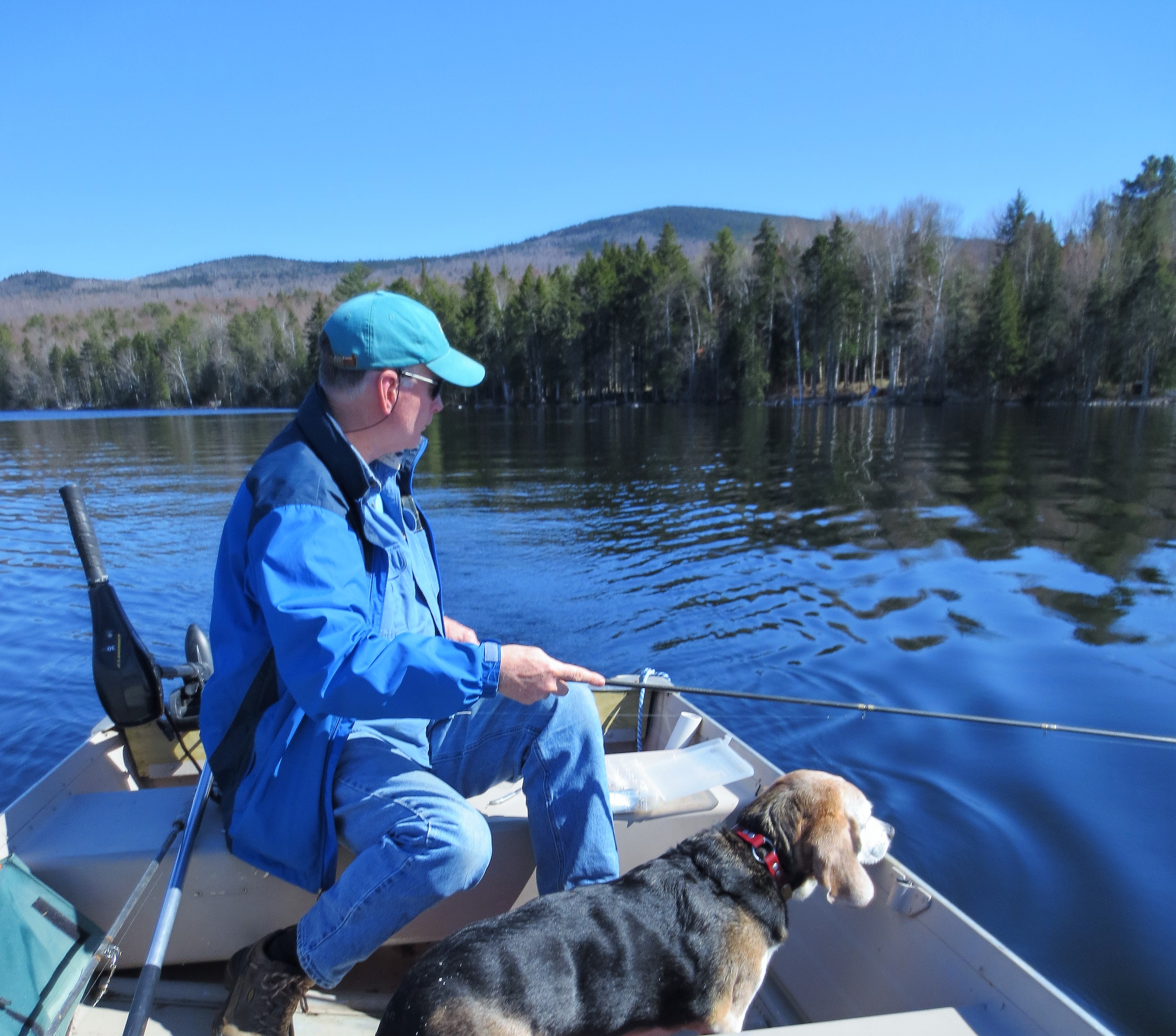
In the end, Kineo gave me the gift of one more boat ride, of watching his ears flap softly in the breeze as his nose tried to hoover out every last early summer scent coming off the lake. He devoted all of his days to making the best of mine, of ours. He shared the wonder of living every moment close to the earth, far from worry. And the grace of going peacefully, gratefully, when the time was right. He came to us a dark, stocky little puppy, ready to live up to his rugged Maine mountain name, and left a wizened, lumpy old hound happy to just waddle around after us and sleep in the sun.

On the afternoon of my birthday, Kineo listened mostly with his heart as I smiled through my tears, kissed his old grey head, and whispered one more time. “Thank you for being my dog again today, and the best dog ever. My Lord Bemis camp beagle, ruler of the afghan realm, the far rug regions, the tall pillow plateaus, the deep, dark blanket bayous, the vast, uncharted forest floors, and all the known couch counties. For being my sultan of the Subaru, titan of the Toyota, baron of the biscuits, guardian of the garden, and prince of the porch piddles. For living in regal beagle splendor all of your days, until this last day, Mumma’s birthday, the twenty-seventh day of May in your sixteenth year Atta Doggonie.”

And then we closed the circle.

Home groan…Easter grass

With all the strides made lately toward ecological awareness and responsibility, how come green cellophane Easter “grass” still shows up on the store shelves? Isn’t it a bit ironic that McDonald’s has been forced to develop an environmentally sound alternative to Styrofoam while employees at Bunny Turf, Inc. are still shredding up heaps of neon green strips with a half-life of 200 years?

Back when I had to deal with the stuff as a necessary evil of young motherhood, I told myself I’d like it better if it was somehow recycled—re-purposed from some equally annoying product. Instead of making all those strips from scratch, I always thought the Bunny Turf people should maybe reuse the see-through parts of the Publishers Clearinghouse envelopes I threw away by the truckload each year. Add a little green dye, chop and re-bag it, and presto…one bothersome by-product replaces another! But by June, still finding the glossy clumps rooted in my carpet and underneath my couch cushions, I’d see the flaws in that thought process. No commercially recycled product could ever come close enough to the real thing, I realized, since there was no way of recharging each teensy fake blade with a thousand volts of static electricity. And without that characteristic cling lingering long after the Cadbury eggs have disappeared, the product just wouldn’t be genuine Easter grass.

Of course I didn’t always hate the stuff. I once welcomed its emerald plasticity as a sign of the season the same way I embraced cotton candy on opening day of the fair, Twinkies returning to my lunch box, and those bright yellow and orange corn syrup kernels that came out of hiding each Halloween. I even liked the feel of it, stuffed all springy and bright in my basket the night before Easter, full of promises even better than anything that was bursting forth in my back yard. By morning, this special nest would cushion my stash of chocolatey eggs, little pink and blue marshmallow chicks, and whatever else I could grab before my taller, faster sister plucked it out of hiding.

I bought my daughters their first bags of grass with the same childish exuberance. How precious they were going to be, I thought, prancing around in their little footed jammies looking for what the Easter bunny left and laying it reverently in their very own clump of virgin turf! But somewhere between then and the fifth year I had to rip the long green plastic shreds out of the bowels of my vacuum cleaner, I became less enamored. “I am never buying this crap ever again!” I vowed. “It’s like tinsel on steroids!” As soon as the girls’ Easter haul was eaten and I had re-purposed their baskets, I’d scrape as much of the stubborn tendrils into the trash as possible and pray that my Hoover Wind Tunnel could manage the stragglers. I actually did succeed in removing it from my premises long enough to imagine that, if I put out really big solid chocolate bunnies that year, the girls wouldn’t notice their baskets were bare on the bottom.

“Happy Easter!” one of the Grammies announced the next day, holding out a new basket for each girl. She had been to the dollar store and loaded up on jelly beans, plastic eggs she’d stuffed with spare change, and enough Easter grass for the new millennium. That’s when I gave in, stopped allowing my Easter grass grudge to dampen my holiday gaiety, and finally accepted a few elemental truths: 1) I would not have to buy more Easter grass; but 2) I could also never hope to remove it from my home because 3) the Grammies would always bring more. They had a direct line to the original source, it seemed, plucking from what they began hoarding circa 1958. (I know, because one year in Becky’s allotted clump I found a retro foil Hersey’s wrapper from my favorite candy when I was her age.) Before long, I became pioneer mom for my own “green” movement, stockpiling my ancestral ball and—except for what I lost once in a batch of dirty socks—cramming it all back into a dusty Hannaford bag in the closet. Then, when the girls finally admitted they believed a giant rabbit hopped into their living room with candy only because of the candy part, I dumped the mother lode, bag and all, into the trash and watched Waste Management haul it away.

But it seemed like just a brief moment in time before I wanted it back—that foolish, ancient clump of plastic grass and all the memories that went with it. “I’m so glad you had Easter grass!” I said to the Walgreens clerk the day before Easter some years back. “I like the green, but it’s good you had pink and yellow because I bought my girls these matching pinwheels, too!”

“That’s nice,” she said. “How old are your girls?”

“Twenty-two and 26,” I answered.

Old enough to appreciate how perfect the grass cradled the “big girl” treats their dad decided to hide instead of chocolates. He thought it might be really fun to do one more Easter egg hunt with the girls before we moved to Rangeley. And do it with liquor store nips. He was right.

I have plenty of time, they tell me, before I’ll have to start garnering my own grandma load of grass. Meanwhile, I might just surprise them with a new Easter tradition and load up a couple State of Maine-shaped Easter baskets I saw advertised in Down East magazine. I figure I can load a ton of candy in a big basket like that, stretching Twizzlers all the way from Fort Kent to Kennebunk, and nesting a couple Reese’s eggs down in Eastport. Only thing is, I’ll have to line it all with brown grass to be regionally correct this time of year…and remind them to never assume what’s hiding up around Rangeley is a Milk Dud or a chocolate-covered raisin!