Sharing my adventures, anecdotes and, hopefully, some sage advice about re-rooting myself to live by the lake – simply but abundantly – in my one true home: Rangeley, Maine.
For more than 20 years, Mother’s Day meant time to go back “upta camp” to rake the leaves, dust off the cobwebs, and watch the lake warm up before declaring it summer-ready and heading back to New Hampshire. Time for my girls to bestow their annual, handmade Pine Tree Frosty gift coupon/card and whatever trinket their allowances allowed, even though I told them to save their money.
“Mumma doesn’t need things,” I’d insist. Being with my family, happy and healthy, and back in Rangeley, was the best possible gift. As my pile of un-cashed ice cream vouchers grew, so did my memories of this fleeting weekend in early May when the promise of warm days by the lake stretched ahead like a mirage. Inevitably school, work, and my maternal duties in my “regular” house crept back into focus so that, by mid-summer, I’d be grounded in truth: I was a split-personality mother leading a seasonal dual existence. My family’s residence—a house with more space but a lot less charm—was three and a half hours away from our true home, our real base camp in Rangeley.
On Mother’s Day 2010, I made a colossal liar out of myself. Sitting in my Adirondack chair watching the lake “turn over” from another winter, I wasn’t the least bit remorseful, though. I’d come to find out there was an even better best possible gift for Mumma. Being right here with my family, happy and healthy, and staying here was all I ever needed and then some. Beginning with that one monumental weekend, I did not need to pack and head for “home” as soon as I got settled in. I was home—for good—a bona fide year-round Rangeley resident! Faith, family, determination, and a touch of insanity bought me my fairy tale. My life was consolidated, my pared-down possessions tucked snugly in my now-just-big-enough cabin. With home base and its newly-added upper stories peeking out of the birch boughs behind me, I faced the lake and let my head align with my heart. I could stay put now way past “camp closing” time, to see the big lake ice over again, to be there still for the next spring turning. “Priceless,” I said, and gave myself a big motherly hug.
This Mother’s Day weekend marks four years since my Big Move. Just before I pulled the plug on my old life (and my higher-speed Internet connection) and left New Hampshire for the last time, I posted the following thank-you note on Facebook:
I will be celebrating Mother’s Day in my “new” home by the lake, sending love to everyone who made the dream possible. To my three mothers….Mum, who gave me life and who shows me every day how love lives on in Spirit; to Prudy, my step-Mom, who helped me love myself as a grown woman while seeing the wonder in all things; and to Ruth, my Mother-in-Law, who taught me just in time, the healing power of unconditional love. To my beautiful, strong, funny, amazing daughters, Helen and Becky, who mother me back, but keep me young at heart and always eager for adventure. (Thank you for chosing me in this lifetime!) And, of course, to Tom, my husband and forever friend. Thank you for the courage to take this free fall, for the wisdom and common sense to bring our “craziness” into the realm of possibility, for keeping my feet on the ground and my head in the clouds, for laughing with me and loving me all ways, and for always just being with me by our big, beautiful lake.
I’m still saying thanks every day since I wrote that. I thank my three mothers in Heaven for bringing me, collectively and in their own separate ways, to where I am today. I thank my daughters—for knowing I don’t need things because letting me scream like a 10-year-old with them on a mega-coaster or a whitewater raft is better than any trinket. I thank Tom, my best friend, for building this life around me and still wanting to share it with me, even through the long, cold Rangeley winters. I thank my girl friends, my soul sisters, who nurture me like mothers, and love me unconditionally for who I really am. I thank my work family, for enabling me continue my financial security out here in the woods, for helping me prove to myself and the rest of the traditional business world that earning money is just as much of a blessing as having the freedom and the enthusiasm to enjoy spending it. And, more than ever on this Mother’s Day, I thank myself, for just plain being—here and now—hugging myself in my camp chair, at peace with all that I have and have lost.
Forty years ago, I thought my joyful Mother’s Days were over. I’d proudly bought my mother a set of stoneware salt and pepper shakers with some of my $1.80-an-hour paycheck, even though she’d told me to save my money. “As long as you’re happy, I don’t really need things,” she said. “But thanks honey, they’re lovely.” Grinning, she set them in the dining room hutch for “special company.” Fortunately (and unfortunately) I had no way of knowing that was to be our last Mother’s Day. I was 17, madly in love with Tom, getting ready to graduate high school and head into my “best summer ever.” Mum died suddenly a couple months later, leaving me to stare angrily at the salt and pepper shakers and all the nick-knack gifts I’d given her that seemed so hollow. Happy? If happiness was what she really wanted for me, from me, how come she’d just taken all hope of it away with her forever?
But neither did I know then that mother-daughter chats wouldn’t stop, that the wisdom and support would come to find a different, more powerful, communication channel. I didn’t know then that, today, I’d be so relaxed in my camp chair, a mother of two grown women myself, surrounded by what I choose to bring into focus, nurtured by laughter and love that never dies. Happy. Blessed. Rooted in Rangeley—with a huge stack of coupons to the Pine Tree Frosty yet to be cashed.
Twas nearly 40 Valentine’s Days ago when Tom first called me his little boogma. I was so thrilled to be anyone’s boogma, especially his, that I loved the sound of it. I didn’t even stop to think how he might have come up with such a label but, instead, took it as another sign from the universe that he was my soul mate. I had a brand new word that no other guy was saying to no other girl—one he had concocted on a whim because nothing else fit! In my mind and heart, he was already a part of my family.
Wikipedia callsthis neologism—making up a word that only holds meaning for the person who first utters it, and for those who later come to understand its usage. Medical references claim it’s psychotic, probably the result of brain damage or mental imbalance. I call it good old family dialogue and say the medical exerts are full of snash. Our special dictionary is colorful, historic, and only slightly insane. And I’ll proudly add pages to it as long as I can continue to hold a thought and morph it into an expression. Following is an abridged chronology.
dockanoon (circa 1931)
“Please don’t make me go in the attic, Mommy! The dockanoon lives there!”
One of the earliest made up words in family history, this came from my Dad (Mac) when he was about three years old. Late one afternoon, he got a little adventuresome and toddled up to the attic and there it was way up under the eaves, a menacing monster waiting to prey on little boys who ventured out on their own. Much later, he figured out it was a actually a dress form his mother (my Nana) used for sewing, silhouetted by the sun setting through the attic window. He never dropped the word, though, and made sure to pass it down to me and my sister as soon as we became afraid of the dark, too.
oopergawsis (circa 1958)
“Be careful of the oopergawsis when you jump on Daddy’s lap.” We were just old enough to get rambunctious and still young enough to be scared stiff by dockanoons and other monsters when Mac coined this one. Much later, he’d explain we hadn’t yet learned how boys were different than girls, and the proper terms for their private parts. We hadn’t even had a chance to make up our own naughty names. So, in order to protect himself without getting too graphic, he tried to convince us that an “invisible” monster sat on his lap and was easily disturbed. My sister saw through that story, though. The first time we visited the zoo, she took one look at the male water buffalo, pointed, and exclaimed to everyone within earshot: “Mommy, look at the huge oopergawsis on that one!”
snash (circa 1965) “I know that you stole all those cookies, so don’t give me any of your snash!” My cousins and I inspired this word when we were spending the weekend with Nana, our original neologist. We were mischievous preteens, pushing her boundaries and figuring she was too off her rocker to be wise to our antics. We burst out laughing the minute she said it, and snash went down in family folklore as Nana’s gibberish word. Very fitting for someone so easily flustered who wrapped up empty boxes and gave them to us at Christmas. She could remember coming over on the boat from Scotland, but couldn’t remember lunch, so she compensated with Nana-speak. Or so I thought, until I finally looked up snash while researching this post. There it was, right in the Urban Dictionary, common Scottish slang for “verbal insolence.” I stand corrected, Nana! Guess you brought a bit of ancient dialect over on the boat with you and your dockanoon.
gutchies (circa 1974)
“Guess I gotta do laundry so I’ll have some clean gutchies.”
The first time I heard Tom say this in college, I thought it was odd that he nicknamed his undershorts. Then I remembered my own rich history, and was kind of jealous. Why hadn’t I come up with that? It was long before anybody called ’em tighty whities, when only grandpas wore boxers, and I could have been a trend setter. Tom claimed it was his brother’s term, not his. And all these years I believed him, until I finally consulted the Urban Dictionary and learned the truth. It’s a for-real word, supposedly originating in Pennsylvania. Generally not depicting the spiffy, new briefs modeled by Michael Jordan in the Hanes commercials, it can refer to women’s panties, too. Not the Victoria’s Secret variety, mind you, the 12-pack Walmart kind. Who knew?
wlak (circa 2000)
“Jasper’s a good dog, so he deserves a long wlak.”
Some of my most memorable neologisms, including this one, come from not thinking as fast as my mouth is moving. I was attempting to verbally spell out W-A-L-K so our beagle didn’t bust a gasket hearing me utter the actual word. Well, I did better than that by making sure he could never decipher my alphabetic code! Two beagles later, we are still taking the dog(s) out for a wlak.
stugged (2009)
“The table legs were rickety, so Tom reinforced them and now they are stugged.”
I didn’t realize it till later, but when I came out with this one, I was actually following the footsteps of Lewis Carroll and other literary greats in creating a portmanteau—lumping two words together to form a new one. At the time, I thought I was simply admiring Tom’s handiwork. He made a table sturdy + rugged = stugged. Now I use it to describe everything from a well-built backpack to my legs after a long snowshoe.
slub (2012)
“What kind of a slub leaves her wet bathing suit in a lump on the lanai for the rest of the day while she sits and drinks rum punch?”
I won’t confess how many of my portmanteaus I have set free while enjoying a cocktail on vacation. Suffice to say, though, the combination seems to create a fertile environment for some of my most memorable self-expressions. Slug + slob = slub. Somehow, I seem to be more comfortable being a tropical slub than a Rangeley slub. Even with a homemade wine cooler in my drinkin’ jar down by lake, change of latitude, minus 30 degrees Fahrenheit, minus rum does not seem to create the same result. Go figure.
Fredded Shosted Wheat / Shark, Puddle and Fly (ongoing)
“Before you open the new box of Cheerios, I want you to finish the Fredded Shosted Wheat.”
“We used to leave our car at the Shark, Puddle and Fly. Now we take the bus to Logan.”
I blame proficiency in this sort of word art on my mother’s love of spoonerisms. Before Wikipedia defined them as “errors in speech or deliberate plays on words in which corresponding consonants, or vowels are switched,” I knew them as cheap fun around the dinner table. She retold the story of Rindercella and her prandsome hince so often I think it must have triggered the spoonerismsynapses in my cerebral cortex. I now carry on her legacy with pride and panache.
camp frau (Present)
“In the middle of winter, when she hasn’t been into Rangeley or down the mountain for awhile, Joy begins to feel like a camp frau.”
This is my own adaptation of house frau, a term I heard my mother-in-law use when talking about living in Germany in her younger years. The house fraus in her neighborhood were stuck in a rut by choice, it seemed, Germany’s version of Donna Reed or June Cleaver without their modern appliances or naturally sunny dispositions. They wanted to be housewives, to have no aspirations greater than polishing silverware and making sauerkraut. The tone she used when she spoke told me my mother-in-law wasn’t one of them, and made me pray to never become her son’s house frau. Sometimes, though, when the days get short, the snow piles up, and I wonder if I’d be a better woman if I swept up around the wood stove one more time, I do feel like a camp frau. But then I remember: Due to temporary circumstances and wanting to live the good life in God’s country, I am a cabin-bound woman, not a camp frau. I am a lucky little boogma.
—————————————————————————————
For other Valentine’s Day posts, see:
I squinted across the parking lot and sighed, letting the humid breeze blow away the last traces of airplane air. There was no rush, really, no need to dash around, check my watch or even wait closer to Tom so we didn’t lose track of each other in the shuffle while he got the luggage. Because, I reminded myself, down here there was no shuffle, no tight schedules, no worries. There was one runway, an outdoor luggage cart with ours in plain sight ready to grab, and a long, lazy month in a beach house just down the road.
I already knew what to get at the small market on the way to the house, which drawers I’d use to stash my stuff before shoving my suitcase under the bed, how I’d lay my mask and fins out on the porch till morning and my swimsuit in the little wicker chair by the deck. I’d sit in the cabana with my daughter, Becky, on her days off from teaching at the Island School, just exactly as I’d done when I’d stayed there over Christmas. It felt so good to be back, to be waiting outside the airport repeating it all in my mind with calm certainty that nothing had changed a bit. While I’d gone home to three months of Maine freezing and thawing, Rock Sound, Eleuthera, Bahamas, stayed exactly as I’d left it.
When it comes to being on island time, I’m usually there before the plane even lands. I feel the change coming over me like a deep cleansing breath and, as soon as I can swap my L.L. Bean boots for Tevas, I’m back in the groove. But today was different. Today was April 16, 2013, the morning after the Boston Marathon bombings—and by the time I made it through the sentinel of security at Logan Airport, past the “what’s going on in the rest of the world” news coverage in the Nassau departure lounge and, finally, to the remote end of this out island—I felt like I’d escaped much more than mud season in Maine.
Hauling his huge rolling duffel packed with more snorkeling and fishing gear than clothing across the parking lot, my husband, Tom, seemed to agree. He looked up at the palm trees with a weary, but expectant smile that told me he’d reached the leg of the journey when horsing stuff around was no longer a hassle. The exertion was now earning him rum drinks.
“Luggage is all here,” he announced, and I nodded. Despite sharing an adventuresome streak that lands us far and wide, we still find comfort in stating and acknowledging the obvious along the way. I, especially, have a need to repeat things out loud to myself—our flight numbers and gate numbers, our departure and arrival times—re-reading them from the itinerary I keep in a giant paper clip in my carry on, reciting them off the airport monitors, again when we get to each gate and, finally, hopping up and echoing the boarding announcements as they come over the PA system. Fidgeting over the reservations, the little details, then freewheeling how they actually come to pass is, after all, how we manage to venture so far off the Carnival cruise line. Once again, a fine-tuned balance of focus and faith carried us from the JetBlue Airbus 320s, through the bowels of the “domestic” terminal, and on board an island hopper turbo prop, leaving the dolphin encounter brochure families back in Nassau.
We also left behind Comfort Inn, McDonald’s, Verizon wireless, and Hertz Rental Car. I did make arrangements for a car, supposedly, the same one we’d driven back December. But I had no rental contracts, no formal agreements, no guarantees. “This is where the paperwork ends and the trust kicks back in,” I reminded myself. The more I scanned the parking lot for the ancient RAV4 that wasn’t right there waiting for us when we landed, though, the more I wished I could rifle through my clip full of printouts for some verification, something with today’s date on it, somethingofficial. Visions of the armed guards and bomb sniffing dogs that surrounded me in Boston crept back to mind, and I couldn’t help voicing how vulnerable I felt standing so far from home, waiting for one man to fulfill his promise: “Whereis Coco?” I demanded.
You just couldn’t be in Rock Sound for more than five minutes without seeing Avian Morley, AKA “Coco.” Besides being the go-to guy for transportation, his restaurant/bar/conch stand was the most happening place in town. Heck, even Martha Stewart and her camera crew managed to find him, lured from afar to taste his legendary conch salad. Plus, to me, he was the face of Rock Sound, the essence of what it took to thrive on the sleepy end of this out island. The minute I met him back in December, “gotta see Coco” stopped having much to do with practicality and logistics, and became all about wanting to just be around him. Yup, I told myself, if there was one thing I was pretty sure I could count on in Rock Sound, Eleuthera, on the morning after the Boston bombings, it was finding Coco again.
“Hey, hello and welcome back, dahlin’!” he greeted, coming across the parking lot with car keys and a big bear hug. I was struck again by how much he reminded me of someone I couldn’t quite place. It didn’t matter, though, ’cause I’d found Coco again. And the way his huge, easy smile felt the same as looking out through the clouds from the puddle jumper plane to spot my first glimpse of turquoise water, so vivid but tranquil over the long stretches of white sand, was all I needed to know for now.
“Coco! So good to see you again!” I said. “Hope you didn’t wait here too long. And, oh, we do want the car for four weeks, but our bank back home has a maximum per-day ATM withdrawal, so we’re going to have to pay you cash in several chunks so you don’t get hit with a MasterCard or check cashing fee.” He nodded, smiled, and walked us over to the familiar grey RAV4. “No problem, no problem,” he said.
Classic Coco, I thought, climbing back into the banged up SUV. It was hard to tell if the odometer had moved in the last three months since it was still hovering around 200,000, and we were still too hesitant to do the kilometers-to-miles conversion. “You sure this thing has enough ground clearance to get us down the remote beach roads?” I’d asked the first time we saw the RAV4. According to the Eleuthera travel guides, venturing off the Queen’s Highway to explore could be as risky as it was rewarding, and I found myself remembering how a gorgeous tropical view hadn’t helped Tom Hanks much in Castaway.
“No problem, no problem,” Coco said. “Drive slow.”
Hadn’t I heard that tons of times in my travels! No problem, mon. Usually it came across as the island way of saying there really was a problem, but we want you to calm down, chill out, have another rum drink so you don’t notice. That’s what you tourists expect us to say…pay us to say. When the boat captain on my first trip to the Bahamas told me: “No problem, dahlin’ we go snorkeling today,” it meant even though it was hailing and blowing a gale, I just needed to have another Goombay Smash and get on the boat. Even back home at a local concert hall, I heard the manager for Bob Marley’s sons’ reggae tour say “No problem, we’re on island time,” to the volunteer usher ladies (who seemed all the more perplexed by dreadlocks). I’m pretty sure it meant the musicians chillin’ out in their tour van (right next to the police station) an hour after the concert was supposed to start were not experiencing any hassle.
When Coco said no problem, it was different. His way was like a mantra, half lullaby, half chant, a personal affirmation that “every little ting gonna be alright.” Hearing him repeat it over and over, I could believe and make it my own truth—whether I was bouncing down a jagged road in a rental jalopy, or trusting that he could just shut down his entire restaurant on Christmas Day to invite us and a small gathering of other “locals” to dinner. “No problem, no problem,” he said when Tom got his wallet out and tried to pay for the bottle of wine we drank with our turkey with all the trimmings and fresh banana cream pie. “You’re family now.”
Other vacationers told me they came to Eleuthera for the people, by-passing islands with more amenities, but less soul. That Christmas night, as I watched the annual Junkanoo festival, I understood. The residents from Rock Sound, Tarpum Bay, Governor’s Harbor, and the other communities linked together on their skinny strip of limestone between the Atlantic and the Caribbean were family, parading by in one big celebration of life and tenacity, and I was mesmerized from my eyes down to my swaying torso. The costumes drew me in, colorful and gaudy as the tinsel-covered Christmas trees I’d gawked at as a child. Somehow, too, the drum beat and the rhythm of their age-old dance of joyful defiance filled me reverence, the kind I’d get gazing up at stained glass windows in a candlelit church. The brass section tooted by, keeping it upbeat, and I was whisked out of church, back to the roadside revelry. Had I ever been able to leave that moment in time, rooted there near Rock Sound with my family, I actually could have dreamed I was just a bit off Broadway. Then along came Coco, king of his community’s Junkanoo band, dressed like a Bahamian police constable, dancing with all his might and clowning around for the crowd.
It wasn’t until I got back to Eleuthera in April, and I was sitting in Coco’s restaurant watching his Junkanoo video, that it finally hit me. Big Papi! He was the David Ortiz of Rock Sound, Big Papi without the beard, or the bat, or the big baseball salary. Plus, while he didn’t have the same bling as the Boston Red Sox MVP, he lit up that parade route like a shimmer of diamonds. “Can you please make me a copy of this DVD?” I asked Coco.
“No problem, no problem,” he said. But I never saw it, or Coco, again. Coco died in a motorcycle crash in September, just up the road from his last, jubilant march. I heard the awful news as the fall colors were fading back home in Rangeley, Maine, and the air was taking on a chill that made me dream of dancing barefoot in the Bahamas. I’m no stranger to grief, both the kind that stabs me swiftly in the heart, or drains me slowly like a wound that can’t heal. Still, the loss of Coco stunned me to my core. How could I miss someone so profoundly I was pretty sure I was never going to see again? Now that Becky had finished teaching down there and moved to Boulder, I should have been better soothed by happy memories of time spent with a great guy on a laid-back island. People come and go, after all. And sometimes I’d end up wondering things like “whatever happened to that guy who used to work here….he was nice.” I’d find out he’s not coming back, observe a moment of silence, shrug and move on. Not so with Coco. Not even close.
The night Becky called and told us, Tom and I looked out over our lake and toasted Coco, drinking the special Rangeley Red Juice liqueur Tom made from raspberries we picked in the warm August sun. We wished more than anything that Coco could taste it with us, beaming his approval. We drank to living life in the moment—and to the mixed blessing of having a friend like Coco, now gone, who left a legacy of how we’d treat ourselves and others in his memory.
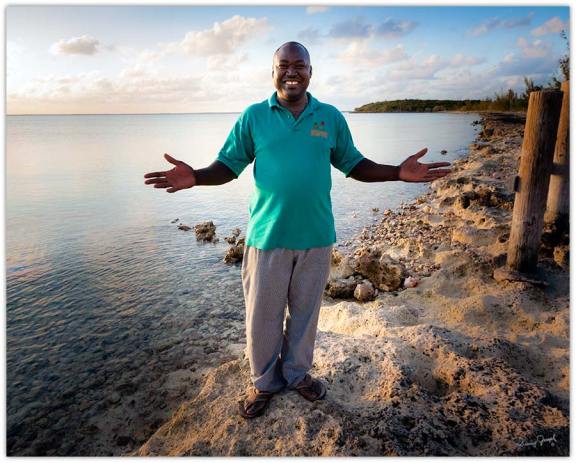
I cried a lot over Coco. And with Christmas coming around again, I’m sure I’m nowhere near done. I am finding comfort, though, in a picture I keep near my desk. It’s Coco, in his element down by the clear, blue water, palms up and arms spread wide, grabbing all life has to give. He sort of reminds me of the the giant portraits that, as a kid in church, I thought only Christ could pull off. Striking a “come to Jesus pose,” He’d conjure up a powerful spirit vibe I figured must be reserved for the Son of God Himself. As an adult, I now believe the spark comes closer to earth. It moves through people like Coco, who show us how to carry Heaven with us, day by day, in our attitudes. Each time I see his picture, I now also know that it’s my bittersweet burden to always remember, to always radiate how he made me feel—instantly special, a forever friend.
Hard to believe it’s been three years since I first hit the Publish button on this baby. Looking back, I’m once again thrilled and humbled by those of you who continue to find me, however you can, and apparently aren’t scared off by your first visit. Month after month, you’re growing Rooted In Rangeley deeper and wider, letting my ramblings reach far beyond the tiny corner of the woods from which they sprout!
Definitely a high point in the year was being discovered by and featured on the first-class Rangeley-Maine.com website. It made me feel validated, practically syndicated, and all the more inspired to spread my rustic wisdom beyond folks up here—to those who wished they were up here bad enough to log on and read about it every chance they got. Even other country far away folks were wanting to read about all things Rangeley, I discovered, when a fan from Croatia left his comments and a pretty cool flag icon in my daily stats feed. Then, when a bright Bahamian flag showed up soon after, I knew I’d gone global big time. It made for some pretty colorful blog demographics indeed until my daughter, Becky, moved home from the Bahamas, cutting my international audience in half.
Still, each day adds new surprises to my search term history, evidence I am somehow roping in readers from the farthest reaches of Google and Bing. And just when I think I’ve touched the outer limits of social media, along comes a fan like “evil_squirrel_13” to show me otherwise. Who was he, I wondered, as I followed his crumb trail off my comments section and onto his blog. And why did Evil Squirrel 13 “like” Rooted in Rangeley?
“If you are visiting because I liked and/or commented on one of your posts, welcome to my little world!” his blog explained. Called Evil Squirrel Nest, it was illustrated with his squirrel cartoon drawings and dedicated to all things squirrely. “I do random daily searches for “squirrel” on WordPress, and read the most recent posts containing that word. Even if it has nothing to do with squirrels, I will still hit Like if I enjoy it! It’s interesting to see the variety of blogs and bloggers there are out there on the internets!”
“Wait,” I said to myself, “through the marvel of technology that allows a WiFi signal to beam across Bemis, broadcasting my innermost thoughts from the Bald Mountain broadband tower—out into the same worldwide web used by Steven Hawking and all the great thinkers and doers of our era—I connect with squirrel guy?”
As near as I can figure out, the decoy phrase came from one or two postings. In Signs of Spring, I wrote: “Folks in other social circles are blaming this year’s tough winter on a mixed up Ground Hog’s Day prediction. Back in February, he emerged from his hole and said spring was just six weeks away. The nerve of that wood chuck! How could he and his stuffy handlers come out with all their pomp and circumstance and say that? Aren’t there laws against false advertising? Shadow or no shadow, I wasn’t paying all that much attention. Up here, we don’t have Punxsutawney Phil or anything close. We have a bad ass red squirrel who hangs out in the shadow of the wood shed hogging all the bird seed, and he’s not real prophetic.”
And more recently, speaking of the luxury of Staying Past September in Rangeley, I remembered the years when, after driving uptah camp: “We’d pile out of the Subaru and scatter like squirrels, a flurry of divergent activities fueled by the common purpose of getting going with summer.”
I think it was the squirrel cussing, the rough bad ass red squirrel language that ultimately lured Evil Squirrel to my site. Serves me right, I guess, playing with the power of social media, putting myself out there until—a couple misplaced rodent references later—my cyber network sprouts a branch I never knew anyone would bother to hang out on.
Just kidding, Evil Squirrel, I’m sure we’ll cross paths often. After all, I do live in a cabin in Rangeley year-round and, squirrel talk will, therefore, find its way on my blog regularly. Squirrels eating Tom’s strawberries. Squirrelsscurrying around the fire pit and screeching from the treetops. And, especially, the pink little eraser-sized squirrels birthed into a mitten left hanging on the screen porch till their squirrel mamma carted them one by one back into the woodshed. (Right there alone, we’re talking six hits on my blog from the squirrel search engine. Ooops…make that seven!)
And just so my new fan will know he’s in good company when he revisits, I’ll now pay tribute to this year’s whackiest random blog viewers. By random, I mean these folks are not my regular acquaintances, or those who log on because I wrote the URL on a cocktail napkin they stuffed in their pocket, or even those who get curious because they heard about the “Rangeley blog lady” from a friend of a friend. Here’s to the best of this year’s Rooted In Rangeley search terms and the wayward surfers who found their way to my corner of the lake:
Rooted where? My search engine database is still logging plenty of “rootedinrangeley” attempts and a wide variety of spelling variations on my name and my location. Turns out, I am “routed” here and, some would say “rotted,” but usually just “joy’s blog in Rangeley.” Once I was even found at “My Fork in the Road, Maine.” (On occasion, I do confess to Googling my own self, just because I can. My blog publisher claims it doesn’t add to my reader tally, but it’s still fun to play cyber boomerang with myself now and then.)
Trip advisor (not!): Some people seem to have stumbled across me in their eagerness to discover all there is in to do in here in God’s country, and then some. They might come up in person, but only if they can figure out when the “worst mosquito months in Rangeley” are, what time it actually gets dark here, when will the lake freeze over, will the “Purple Onion” still be serving and, especially, will the transfer station (aka dump) stay open despite everything.
Woodsy Wikipedia: The 2013 award in this category goes to whoever was trying to figure out “What are the white bugs on my windows in Rangeley in October?” Most likely, this query came “from away” because anyone in my audience who really stays put up here past the end of September knows the true possible answers. The easy one is: “Those aren’t bugs.” Bugs, thankfully, get freeze dried soon after Labor Day. What’s white and is clinging to your windows in October is either, a) snow; or b) wood stove ashes blowing back toward your house on a stiff lake breeze; or c) a combination of both.
And the top wackiest surfer prize goes to… If search engines suddenly powered down, everyone knows that all forward human motion would stop instantaneously in its tracks. Never mind blogging, we couldn’t work, drive, shop, eat, date, or learn either. Even so, there are times when Googling is not called for, and stopping to surf the net should not be our first course of action. That’s the thinking behind this year’s wackiest random reader search term award. Because, no matter how much I enjoy having any and all readers at Rooted In Rangeley, I do believe that whoever got here pondering: “How can I shoo yellow jackets from my shorts?” should not have been sitting still long enough to log in and type!
Seriously, thanks to all my readers for another terrific year. If not for all of you, I wouldn’t be Rooted In Rangeley, but forever trapped in the meandering tumbleweed of my own twisted mind.
It was a Sunday in mid-June when we had to summon my Dad to dislodge a mouse that had been trapped inside the drain in the laundry room sink since early spring. My mother, my sister, and I were standing at the top of the cellar stairs cringing when he finally came up. He lumbered past us with a coffee can bound for somewhere way out back.
“Why am I the one who gets to do these kinds of things?” he asked, flailing the can in our faces. “Just because I’m the only guy in the house? Cause I’m the father around here?”
Ummm….yeah….we all said silently. Dad (AKA Mac) was responsible for plumbing, pest control, and safeguarding the house from intruders. The waylaid mouse met all of those criteria.
I grew up in a one-male household. And, after marriage and two daughters, that status pretty much stuck. No brother tinkering with a truck in the driveway. No son to shatter my theories about the uniqueness of father-daughter relationships. Just Dad, our one-man magic show. Please bear this in mind as you read the following theories. Please also know that my theories took root in the early ’60s when it was expected for females to keep their distance and say things like “Eeeek!”—and socially acceptable for Dads to declare stuff “too messy for girls.” Mine always swore he didn’t miss having a son. But I bet on certain occasions, especially that morning in June with the putrid coffee can, he instantly became a secret liar. If only he’d had a male dependent at the top of the stairs, Mac could have emerged from the cellar with his heart full of gratitude, but his hands empty. “Son, go find yourself a coffee can,” he would’ve said. “There’s a project for you down there.” And the imaginary son of the early ’60s would obey, trying to keep a stiff upper lip and a strong stomach, knowing the chore was ultimately preparing him for manhood—for the day when he’d take a wife and the responsibility for any yucky stuff trapped in his terrain.
When it comes to heroes, a Dad of daughters might as well have a cape and a lightening bolt emblazoned on his chest. Faced with danger and all manner of distasteful duties, he responds, undaunted by extension ladders or jumper cables, by navigating through whitecaps, or even by investigating nighttime noises.
“Yup, it’s a bear,” Mac affirmed. It was a June night back in 1964 and he was peering into the darkness from our tiny log cabin on Moosehead Lake. My sister and I had finally nagged him into determining the source of sounds coming from the front porch. We’d listened long enough from our beds right under the windows to know that, whatever it was, it was much bigger than the raccoon visitors of previous nights. And then we yelled for backup. “Daaaaaad!!!”
In years since, we realized there was nothing even Mac could have done—except maybe spray the bear in the face with the fire extinguisher if it got rambunctious enough to shove the door open. Still, there was something about our Daddy standing in his undershorts stating the obvious that we found comforting.
“Yup,” he said, “and it’s a big bear, too.” After watching it amble away in the dark, he shuffled back to bed himself, grumpy but gratified. Because the only thing Mac was afraid of was not being the rock hard center of our universe. And that was bigger and hairier than any old Maine black bear.
It wasn’t long after I began to watch my husband Tom’s interactions with my own young girls that I discovered it’s not necessarily bravado that stirs Dads of daughters to action. It’s the call: “Daaaaad...” It sounds like a sheep with a bad stomach ache, but little girls have it mastered by age two. And much the same way a dog responds to a high-pitched whistle even though he doesn’t know why, a Dad comes. Instinctively he snatches up a toolbox, a wad of paper towel and/or a plunger along the way, knowing that, whatever it is, if it’s broken, clogged or invasive, it’s his job. From Barbies to bike chains—to those hopelessly gnarled up necklace knots he can somehow unravel with his big, burly fingers—if Dad can’t fix it, it’s history. And if he really isn’t keen on squishing, trapping, or otherwise keeping creepy stuff away from his womenfolk, he has to buck up and do it anyway.
“Daaaaddy! Keep these bees off my peanut butter and jelly!” my first-born Helen yelled from her picnic log down by the lake. She was about three, and Tom had already plucked her out of the Salmon Falls River, showed her the bears at the Seboomook dump, and desensitized her to mice so successfully that she was catching them in a minnow trap and rolling it back and forth across the cabin floor like her own animated Fisher Price toy. She was a new-age girl child, born to a Dad who stood there right in the delivery room waiting for her to show up, even though part of him wanted to be out in the waiting room with his forefathers. She and I had the best of both worlds, an ’80s “girls can do anything” male role model who still had enough Maine woods machismo to build a cabin around us and shield us from vermin. On that particular outing, a nest of yellow jackets swarming our picnic was his call to action—one he definitely did not want to answer.
“Come with Daddy, Helen, we’re going inside now!” Tom commanded. His voice was uncharacteristically shaky and, by the time he’d shoved sandwiches back into baggies and retreated, his face was a non-summery shade of pale. I handed him the big can of Raid we kept for just such circumstances, knowing that its super long spray wand would not keep Tom far enough away from bees—his greatest, and pretty much only, fear.
“Daddy got stung really bad when he was about your age while he was playing down by the water at his camp,” Tom told Helen after she’d watched him do his little extermination dance from a safe distance. “But those naughty bees won’t bother you any more, honey. Daddy got ’em!”
By the summer she turned four, Helen was Tom’s fearless little fishing side-kick and a brave big sister in training. “Look, Daddy, a snake!” she said, pointing matter-of-factly to a place on the dock where I spent hours each afternoon, plopped into a beach chair in my lamp shade of a bathing suit, reading and letting soon-to-be-born Becky kick me like a soccer ball. Had I ever seen a snake anywhere near my spot, I’m pretty sure Becky would have been a preemie.
“Don’t tell your Mom,” Tom said to his little comrade.
Then, somewhere along the way when I wasn’t paying attention, my daughters turned from gutsy little girls into bodacious women of the new millennium. “Better than boys,” I’d tell them, because they shooed snakes out of my path and changed their own tires, but still had all-day pajama days with me. All that plus, well, because they were girls. We were having such a discussion on a recent vacation, just the three of us sitting in a rustic cabana, staring out over bluer, warmer water and enjoying our favorite grown-up picnic cocktails, when Becky noticed something burrowing into the sand underneath where Tom was coming to eat his lunch.
“Hmm, looks like they’re ground hornets,” she said.
“For you, Mumma,” said Becky. It was almost Mother’s Day circa 1991 and she’d just finished her first “uptah camp” breakfast of the season: a Pop Tart skillfully warmed in the toaster oven, our favorite appliance, and handed to her on a paper plate by her big sister. She placed before me a handmade gift which, as usual, was a cross between art and nature and full of kid folklore. This offering was a human image, hand-carved onto glistening paper in shades of neon.
“Ooooh, it’s nice honey! Who is it?” I had to ask.
“It’s you Mumma, you in your bathrobe. Happy Mother’s Day!” How could I not have known? The pointy little head atop the pear-shaped silhouette fringed with hair spikes. The zipper extending all the way down to the crow-like feet. Nobody, not even myself, could ever see me for who I am like my family.
A year or two later, our local paper began running short stories entitled “My Mom” submitted by school children. I remember reading with amusement (and trepidation) some of the sentiments the little nippers thought proper to fit into three or four sentences:
“My Mom has curly hair and green eyes like mine. She works in an office. She likes ice cream.”
“My Mom used to clean house a lot, but now ladies come in a special truck and do it for her.”
“My Mom is a nurse and she takes care of sick people. I am proud of my Mom. Sometimes she gets grouchy around suppertime. She works real hard and needs help. Her hair was gray until she turned it back to brown.”
That was the year Becky’s kindergarten did a similar synopsis, published on a huge scroll of craft paper. “What does your Mom do?” the teacher wrote at the top. The list she transcribed in huge magic marker letters ranged from little kid stream of consciousness drivel about their maternal care givers to the generic “My mom cooks, vacuums and watches Oprah Winfrey.” Somewhere along in the middle was Becky’s response: “My mom goes to Hannaford and types on the computer.” (My circa 1993 priorities in a nutshell, and in the right order, too.) Yup, and in between all that shopping and word crunching, I managed to slap together a few thousand sandwiches, watched her stage debut as a raccoon, and had the alphabet song emblazoned across my brain.
“What would you write about your mother for the newspaper?” I asked Helen. I figured, at age nine, her seniority would afford greater depth of vision.
“Hmmm…I’d write that you love camp, and Dad, and us, and Eric Clapton, but you hate Easter grass…and that you have exactly the same color eyes as mine, only redder.”
So much for aged wisdom! “Nobody has asked you to write anything for the newspaper, have they honey?” I asked, suddenly deciding that was the year I’d settle for magic marker immortalization and hope the media would not be interviewing my offspring. She’d given me my day in the spotlight though when, at age 5, Helen used all her crayons to win the Mother’s Day art contest sponsored by (you guessed it) Hannaford. “My Mom is special because she cares so much about me” it proclaimed to all ‘neath a butterfly-adorned rainbow. No Mommy stick figure to further distinguish me that year, just a short, sweet, primary-colored sentiment posted in the window above checkout aisle 3. And that, plus the $100 grocery gift certificate, was as good as it got back in 1988. Course that was BC (Before Computers), way before I could snap a pic with a smart phone and broadcast my celebrity status to everyone drawing breath. And my babies couldn’t begin texting me as soon as they got manual dexterity and an unlimited family roaming plan either. We didn’t have the wherewithal to universally “like” our kids, to plaster their Facebook walls with little heart emoticons, or to instantaneously show how smiley-faced we were over their ability to share a perfect digital rose postcard with us and 65,312 other one-of-a-kind, “truly soul inspiring” Moms. Back then we had local papers capturing middle class motherhood small-town-America-style, and TV commercials showing kids what they should buy at JC Penney to make Mom look extra special when they took her to dinner at Friendly’s. But, even back in 1988 BC, I do remember attaining some notoriety with my own low-tech social media campaign. “My daughter drew that,” I’d point out to any shopper who happened to wheel past checkout aisle 3. “For me.”
It’s antique artwork now, preserved, framed and hanging above the desk in the upstairs hallway where I store my other Mumma memorabilia. There’s a folder of handmade cards in the top drawer that still gets my attention, even if I’m only rooting around for a pencil. Stuffed full of toddler scrawls, sophisticated custom hallmarks, and everything in between, it holds my personal dog-eared history as seen by my next of kin. Looking back through it all now, I’m glad my daughters took notes, reporting without censure and with a flair for vivid color. Over time, their Mother’s Day messages tracked who I was, how I hoped to be seen, and where I was in my work/life balance spectrum.
“Happy Mother’s Day to the best darn technical writer in the world!” Becky wished me circa 1998 with a creation she printed off our state of the art 300 DPI color printer. It featured a clip art rendition of me, lounging on the beach, snorkel in one hand and pina colada in the other, enjoying the fruits of my new profession with a family vacation. At the time, I remember feeling equally as proud that she put “happy mother” and “technical writer” in the same sentence as I was of the fact that she’d mastered PowerPoint and fancy fonts in the limited time I allowed her to boot me off the home PC.
“Here’s so you can spend Mother’s Day with your favorite people!” Helen proclaimed artfully in another memorable Mumma folder moment. It was during my Mustang years and, with just a bit of help from PhotoShop, she’d morphed our extended family (here and long gone) into my new red convertible along with me and Bono from U2.
After reaching that high-tech pinnacle, the girls’ greetings gravitated away from glitz and back to homespun, to simpler pictorial essays about being my grown-up daughters. Some were spoken, some printed on PostIt notes, some filled all available space in the “blank inside” store bought cards. Each told a tale of love and support, of silliness and adventure, of my special brand of mothering. And the best ones—the ones that said it all—were just words whispered, from younger women to their older one.
“I think you’re beautiful, Mumma,” Becky said softly. We were sitting side by side on the couch the other night and I’d just made one of my more candid body image confessions. I had to laugh at myself and the fact that, after all these years and all her heart-felt affirmations, most days I still couldn’t bring myself to agree. While I’m glad her image of me progressed from those early zipper-bodied, crow-footed impressions she had when she was four, I still need her mirror to show me at my best—to convince me I’m less Dilbert caricature and more classic da Vinci.
It’s been 30 years now since I received my first Mother’s Day card. It was from Tom, who promised me he couldn’t imagine anyone else being the mother of his children. I remember resting the card atop my hugely pregnant belly, crying a few estrogen-fueled tears, and imagining that maybe, hopefully, he was right. And now, thanks to Crayola, HP, and my two lifelong travel correspondents, I have plenty of evidence.
Suddenly, the room filled with as much drama as could be mustered on a March morning in Rumford. Tom and I held our breath, waiting with hopeful trepidation. Watching the flashing electronic numbers climb, then dip, then soar again was like a moment straight out of my favorite TV show. Except there was no music building to a suspenseful crescendo, no Alison Sweeney in a tight dress and high heels wishing Toby luck (and making Tom wish for things he couldn’t have). And there was definitely no Dolvett the trainer waiting in the wings in Spandex, flexing his biceps and flashing his Hollywood smile.
“Thirty-eight point six,” she announced when the numbers finally stopped. “Toby’s gained overseven pounds!” Tom and I did a classic “agony of defeat” expression just like on the show, jaws dropped, shoulders slumped. But teammate Toby just whined a bit and waddled away. Nope, he was not The Biggest Loser and probably wouldn’t be for a very long time. He was an old, fat beagle, plain and simple. And that verdict was about to be unceremoniously verified by Dr. Kent during the dog’s annual day of reckoning at the Countryside Animal Hospital.
For the first time, Dr. Kent’s assistant had to use caution when hoisting Toby onto the exam table, lifting with her knees not her back so they could proceed to prod the hound’s expanding girth. Toby just tried to maintain his footing and a scrap of his dignity, too complaisant to put up a fuss, and much too simple to remember what happened on that cold, hard table last time he was there. A year ago, after an eye-popping search for his prolapsed prostate, the vet recommended neutering. “Plus, while I got him under I should really yank a bunch of those rotten teeth, too,” he said.
“Guess the poor dog needs help on both ends,” I agreed. “And whatever you do, don’t let us leave without a refill for his phenobarbital. Wouldn’t want to be back up in Rangeley and have him start seizing again!”
Seizures, we’ve discovered, are a beagle thing—almost as common in the breed as their unbridled urge to eat until they pop. Luckily, Toby’s seizures are kept under control with Phenobarbital and, luckily, he is the only family member on meds. Preventing his little brain from misfiring means administering small doses of a controlled substance twice a day, blood tests once a year to check for side effects, and stockpiling a steady stash for him up in the woods an hour away from the nearest pharmacy. I’m pretty sure drug cartels are masterminded with less planning than scoring Toby’s pills!
“We’re hoping the poor guy’s liver isn’t shot from the medication,” I told Dr. Kent as he continued to poke and palpitate. “Seems like it’s distended. And his hind end is starting to give out a little. He can barely hold his tail up anymore. I read that was a side effect, too.”
The vet cast us a knowing smile. He was no stranger to old dog owner denial, and ours was a classic case. “This dog’s just fat,” he chuckled. “He’s getting old and he’s eating way more than he needs.” No liver problems. No masses. Just beagle blubber. Turns out that two cups of Purina is an excessive amount of dog chow, especially if the cup measure is an ancient oversized coffee mug, and the dog who’s chowin’ on it is devoid of metabolism-boosting testosterone. Plus the real Catch 22, according to Dr. Kent, is the poor pooch can’t exercise because he can’t exercise. Increased poundage stresses his joints making him unable to walk much faster than a turtle, which results in—you guessed it—increased poundage.
“It’s official, Toby,” Tom announced as we loaded our lard hound into the Subaru and headed back up Route 17. “You’re on a strict diet.” Toby just wagged his tail as best he could and stared out the window, oblivious. The reality of his new regimen would not start to sink in (if anything ever really sinks in) until later. His ritualistic dinnertime prance around the pantry would be rewarded with one measly scoop out of the food bucket and, a few gulps later, he’d be dumbfounded worse than ever as he stared into his empty bowl.
That was over a month ago. And while Toby isn’t saying much, we think it’s slowly starting to dawn on him like an overcast morning over a very shallow pond: his two-scoop days are over. Getting a peanut butter chaser to make his Phenobarb slide down easier is a thing of the past, too. And, instead of pre-washing every dish before it goes into the dishwasher, he’s now left standing in the kitchen, watching me with sad, gravy-colored eyes as I rinse the dishes myself, and his favorite bad habit trickles down the drain. It’s hard, we imagine, being on a doggie diet. He’s got no Dr. Phil or Dr. Oz, no buddy system or online support. He can’t “go out and do something special for himself” because he’s been good all week. He can only go along with the program, his unconditional love for us—his food dis-ablers—still somehow compensating for the growling in his stomach. In many ways, though, he’s got it easy. He has no dilemmas about working healthier eating habits into his lifestyle, no worries about midnight binges, no choice whatsoever in whether he’s going to slip up and put the food bag back on big time. And, best of all, Toby’s got company. So as to not follow in his fat footsteps, Toby’s brother, Kineo, is cutting back too. (He’s still young and pretty trim but, hey, he’s named after a rugged mountain on Moosehead Lake and can’t just be letting himself cave in.)
Toby Tubbette. Mr. Pin Head. Little Fat Boy. Sausage Pooch. Beagle Bongo Belly. As Toby looks less and less like a circus balloon dog stuck too long atop the air tank, our pet names for him will most likely change. But, for now, we’re just glad he stopped walking like Eeyore from Winnie the Pooh while his brother gallops ahead, and that even his “erect tail dysfunction” is going away. Course we won’t get the official weigh-in till next March when we go back down the mountain for blood tests and another drug run. Meanwhile, Tom got an interim progress report the other day when he couldn’t help sneaking a peek on the bathroom scale. “Toby’s lost three pounds already,” he announced after weighing himself, then hopping on while holding onto Toby. Good thing for our beagle loser it wasn’t me getting on the scale with him! Then I’d be dropping pounds, but the numbers wouldn’t even budge for poor starving Toby Tubbette!
‘Twas the day before Thanksgiving and, as usual, the Oquossoc PO was abuzz over hot topics impacting our tiny community. Who was coming to dinner. Who was going away. Who had to cook what for which relative, and who found a new way to spiff up stuffing.
In true multi-tasking mode, I was making the most of my turn at the mail “sorting” station, fishing a couple official-looking envelopes out of the reams of high-gloss junk that, two years later, still finds its way to my cramped cubby hole inside a log cabin post office. I tossed piece after piece straight into the recycling bin, all the while keeping one eye and both ears open to what was shaking “in town” before the big day. “Eat lots of turkey!” folks called as they rushed off to get ready. “Safe travels!” Sending yet another Cabela’s catalog sailing toward the bin, I nodded and smiled. The sentiments would be the same no matter where I roamed. But, while talk of cooking and eating echoed holiday banter most anywhere, up here I know the driving part is a way bigger deal.
“Have a great holiday. Drive safe!” friends called as I headed off to do the rest of my loop. In Rangeley woman lingo, that meant, “If you’re the hostess, may your electricity stay on till the turkey is cooked, and may your family from afar bring all the fresh produce you need. If you’re the one traveling, may you dine in decadence that can only come from a different kitchen, with loved ones all around the table, plus a nice warm bed to sleep it all off in that night. But, above all, be ever thankful you don’t have to go out into the cold and drive back up over the mountain after dark!”
To most well wishers who asked about my Thanksgiving plans, but didn’t have all day to listen to my roundabout answer, I just smiled and said, “You, too! Eat lots of turkey!” I’d be surrounded by loved ones—at a table next to a giant volcano mural with not a scrap of turkey on it. And, while I wouldn’t be driving home after dark, I’d be going way out of the woods, over many rivers, to two airports, and through all manner of toll booths and traffic snarls before heading back up the mountain again.
“What’s that low humming noise?” I asked Tom a couple hours after we’d packed up the Subaru and headed south. He crooked his ear toward the dash and pondered a mile or so. “I think that’s the normal sound a car makes when it goes over 50 and it’s on a paved road,” he concluded.
Good thing highway driving is one of those skills we can rely on to come back to us as needed. By the time dodging traffic gets trickier than pulling over for a logging truck hell bent on its last trip to the mill, and we need our peripheral vision for more than missing moose, we get ourselves re-acclimated. “Cripe, there must be a traffic light every hundred feet or so!” Tom said when we chugged into Rochester. “Did we notice all this stop and go when we used to live down here?”
Yeah, probably, which is one of the reasons we decided to pack it up and move off the beaten track, saving long treks for special family get-togethers or bigger travel adventures. This time, our mission south was special indeed. If successful, we’d eventually get together with family out west, way down south, and a couple points in between. Tom would spend the holiday with his brother in camo out in the Idaho bush, while I’d be with my daughters and son-in-law ‘neath a pagoda in Saugus, MA. But first, Tom had to get to the Manchester airport, and I had to get north again to hold down the fort for a week before coming back down to Logan with daughter #1 (Helen) to fetch daughter #2 (Becky), who’d be flying in from the Bahamas for the weekend to be in her friend Amy’s wedding back in Rochester.
“Phew,” I sighed, pulling down my driveway after the first leg of holiday excursions. “Made it back just before dark!” The trip “uptah camp” was a long pull, especially the stretch of Route 17 between Rumford and Oquossoc when, if I didn’t know better, I’d start to lose sight of what lured me out here. Over the last two and a half years, I’d happily become one of those “can’t really get there from here” folks that people from the other states like to joke about. On the drive back up, as the radio stations went to static and I got too road hypnotized to fish out a CD, I pondered the transformation. Why, I wondered, could I motor for 20 miles into Rangeley to get groceries with a smile on my face, while a two-mile, stop-and-go pass along my old commuting route seemed so out of the way? And why, in comparison, did my long, roundabout ride home—seemingly into nowhere—feel so straightforward? I got my answer as I came around the corner onto the Height of Land and once again squinted down at my little dot of real estate on the tip of a big, wild lake. A few more hills and a bit of long, winding road, and I’d be home.
“If we go past a Walgreens, can we stop for just a sec so I can run in and get some contact solution?” I remembered Becky asking the last time we saw her. It was June and we were in a “busy” section of Portland, trying to find our hotel. Her dad, the driver, did not commit. And the next day we shipped her out of the Jetport to go live on an”out island” in the Bahamas without a last detour into the corner drugstore. Growing up, she could convince us to drive for hours down logging roads in search of moose no problem. But stopping in the city when we weren’t sure if we’d get “turned around”—now that was a hassle.
I made it up to Becky big time, though. Since she wouldn’t make it farther north than Rochester this visit, I was doing what her island friends called a “mule run.” She’d given me a wish list of all the items she thought she wanted but couldn’t lug down there in June. I’d fish it out of the giant totes up in the garage attic, and bring it to our Thanksgiving day rendezvous. We’d see each other just long enough to stuff her belly with Chinese food and her honkin’ backpack with fresh clothing, and off we’d go our separate ways again till Christmas.
“I miss seeing Dad,” she said. “But I’m glad he’s having a nice time with Uncle Jon.”
“He is,” I agreed, cramming in an egg roll while the waiter served a round of tiki-bowl drinks. “Aunt Nancy’s fixing turkey and all the trimmings.” We’d actually be going back through Rochester right around the time of Amy’s wedding reception, I told her. But her dad would be exhausted, and we’d still have a long way to go to get back home. Good thing she’d have plenty of time to see him at Christmas.
Two days and another airport later, Tom was back in the driver’s seat and I was catching him up on my quirky turkey day with the girls. Maybe I distracted him with my verbal meanderings, or maybe something more significant was steering him, but suddenly we were both wondering how we got off course in the city we’d called home for 30 years. “Why’d I come this way?” he asked.
I shrugged, not sure why he ended up taking the “long way around” either. But when we pulled up to the next stop light, we got our answer. Straight ahead and to the left stood the Governor’s Inn, a Rochester landmark, its parking lot filled with guests who had just gathered inside for Amy’s wedding reception dinner. “I’m going in there,” Tom said, making a hard left, “and hugging my daughter.”
And in we went, standing just beyond the buffet table, searching for Becky. We spotted her as soon as we realized our island girl had turned into the prettiest bridesmaid ever. She found us, too, as soon as she realized the only guy wearing a Mooselookmeguntic hat was her dad–on a short Thanksgiving detour, following his heart back home.
Feng shui. I know it’s the Chinese art of arranging your household environment to achieve a balanced energy flow. I know it’s pronounced fung shway because, back when I lived closer to big universities, folks talked about getting theirs checked. They told me I could pay someone to come in, feel the subtle energies bouncing in an around my knicky-knacks, and advise how to get in better alignment. I never did. And now that I live up here in the woods, I’m pretty sure I don’t have any feng shui. I’ve got funky shui.
“Mugs are here in this corner cupboard if you get up before we do in the morning,” the girls tell first-time visitors. “Help yourself to coffee or tea but…ah…just don’t use this mug with the big fish on it, or the red one here, or the brown one in back of it with the picture of the Grand Tetons. You’d mess up Mom’s mug shui!”
Yes, I must agree, they would. It hasn’t happened yet—no one has grabbed the next mug in my hierarchical ordering scheme, forcing me to use the red Moab Cafe one on a day that I was supposed to be drinking out of the big striped bass mug that reminds me of my Dad. And what if someone did? Well, my world wouldn’t spin off its axis or anything too drastic. After a moment or two of staring at the corner cupboard—mumbling to myself in a hoarse whisper and rocking gently back and forth—I’m sure I’d make do just fine with the red mug or the brown mug or, worst case, a tiny flowered one of no special significance.
I’m not sure what the sages would say about my kitchen feng shui. I imagine they might pronounce my food prep surfaces to be inauspiciously aligned. And, although they believe green to be generally conducive to promoting healing and calm, I think they’d concur the particular shade coloring my walls brings too much of a Key West vibe to the land of moose and loons. Plus, what about placing a microwave where I have to bend over to use it because I ran out of counter space above knee level? Well that must definitely “shway” my kitchen off kilter. But, hey, as long as I’m standing in it drinking my coffee from whatever consecutively favorite mug is clean, I am one with all there is, in perfect harmony.
I’ve got some funk goin’ on with my bedroom shui, too, manifested in my inability to achieve total serenity out here overlooking the lake if my bed lies unmade past mid-morning. I blame it on the beagles and how I don’t want them to get dog fur on my sheets. But deep down, I know it’s a control thing, a coping mechanism for attempting mastery over my own little nest. The behavior began when, as newlyweds, our first apartment was nicknamed the Hobbit Hole. Stuck up under the attic eaves in a downtown Victorian, by the time visitors ascended past two floors of offices, they came hunched over the threshold eye-level with my bedroom. My floral Sears bedspread became folks’ first impression of my homemaking skills. (And, now that I think about it, back when I only had a set of “his and hers” coffee mugs, my only kitchen shui on my one open shelf was the Campbell’s cans lined up next to the Norge like art deco.) Then came many working-at-home years in our new split-level house when I never thought much about kitchen and bedroom alignment. I just knew the TV, refrigerator, and all the potential napping surfaces were upstairs while my potential desktop publishing surfaces were downstairs. Making my bed before “getting down to business” kept me aimed toward professionalism and productivity and away and from turning into a Dilbert character.
“What are you afraid of, that the bedroom police are going to come in and arrest you for an unmade bed?” Tom still asks when he finds me scurrying to make it before I start my day. “Don’t be silly, I’m not afraid of that!” I assure him. But I must admit that, while all manner of inauspicious alignment can be hiding in my closet and dresser, I do feel my yin and yang move into equilibrium as I smooth out the last pillow.
Optimal bedroom feng shui, I learned on the Internet, is really more about orientation than tucked in blankets. It requires laying out my sleeping quarters so my head points in the proper direction while I slumber. In my case, based on my gender and birth date, that would be southwest. Turns out, I’m almost OK with my current layout, as long as I sleep diagonally. And even though that would push Tom out of bed, it would actually be better for him since, based on his gender and birth date, he should be aligned diagonally the totally opposite way when he sleeps! Who knew that waking up side by side sharing our picture window view of the lake could be so skewed? To set things right in the same bed, we’d have to sleep crisscrossed like an old pair of skis hanging over the fireplace at Loon Lodge!
“Back when we first built here, we never knew we’d need room for a computer,” my neighbor up the road commented when she showed me her home office tucked into her upstairs bedroom. “Nope,” I concurred. “Never thought we’d have computers uptah camp.” Or kids that grew taller than three feet, or Tupperware with lids, or laundry shelves. Heck, my original cabin never even factored in company who didn’t want to live on the screen porch playing Yahtzee around a citronella candle! And, when we finally decided to make the Big Move to live up here full time—consolidating 3o years of stuff into our expanded but still small space—we never once consulted an energy map, mystical quadrant or feng shui compass. We moved sticky note cutouts shaped like our furniture around on graph paper and hoped some magical, unseen force would help us make it all fit. So, when it comes to office shui these days, my teeny computer desk faces northwest because that is precisely where it has to point me. And the fact that it’s a straight shot across from the broadband Internet tower on Bald Mountain while sitting me smack dab in my best possible feng shui “work or study” spot…well that’s where miracles and coincidences intersect in my corner of the universe.
I do find it nice to know that, simply translated, feng shui means “wind” and “water” and the wisdom of aligning yourself with both. That’s what the online experts told me today when I searched from my place of auspicious contemplation. “Very interesting,” I mused, moving a few steps away from my desk and into my kitchen. With my back to the breezes coming down off the mountains and in through one window, and my face toward the big blue lake in my front yard, I smiled like a true sage and sipped coffee from my chosen mug.
Would I think she was crazy, my friend Lisa wondered, if she came to visit me from her in- law’s place Down East and then drove back to her folks in Connecticut by way of Keene, NH, before flying home to Ohio? Yeah, kinda, I thought. But at least she’d be a good crazy—a sweet old Nana crazy—not the kind that makes you stand at the end of your driveway wearing a tin foil hat and barking at the moon.
Once she got here Rangeley would, of course, be worth going way the heck out of her way. But she’d soon find out that coming “up the mountain” and over to my side of the lake would be more of an adventure than her average drive in the country. It would take more than a quick peek at the Maine Atlas and, before she got to my doorstep, more than a few arguments with herself about the sanity of her circuitous trip planning.
“You call that a bridge?” I could almost hear her yelling when she got to the causeway—the “you can’t miss it” landmark I told her would be a sure sign she was getting close. Like most friends from away (and plenty from in town), the old wooden one-lane bridge marked a pivotal point in her journey. She could dismiss all former notions of marine-grade, Florida Keys calendar picture causeways, aim both tires toward the other side, and forge ahead. Or she could slam on the brakes and recalculate how much a visit to my little GPS grey area was really worth.
But, assuming Lisa chose not to flee or freeze and made it down my driveway, what then? Over the past 35 years, we’d only seen each other once in a blue moon and, even then, it was within a larger circle of friends. Our visits were news flashes shouted above wedding celebrations and New Year’s parties instead of the heart-to-hearts which, long ago, had exposed our common ground. Would what we found back in college still be there for us? Would the bond we had—pre-kids, pre-menoupause, pre-pretty-much-everything—still hold?
I didn’t have to wait till the road dust settled on her rental car to know the answer was yes. Easing down the driveway, she poked her head out the window, grinning like she’d just seen me yesterday, her familiar face framed by chestnut curls still barely tamed by barrettes. “This time, I’m driving a big black couch!” she declared. I had to agree, eyeing her dark Chevy “little old lady” sedan as we hugged hello. “That thing could fit Tom’s Yaris in the trunk!” I said. But it did get Lisa here, safe and sound, swearing she didn’t even mind the drive. And this time, we had some catching up to do.
Many years ago, I walked Lisa out to her car after our friend’s wedding near Framingham, MA, to plan her visit up to my house (then in Rochester, NH) for some quality girlfriend time. “My first trip with the brand new car,” she announced. “It’s a standard.” We rolled our eyes and giggled. Neither one of us took to the highway on a whim. Driving was a necessity. Manual gear shifting wasn’t. For me, negotiating Route 128 with a standard transmission would have been a jolting experience, indeed. “You’ve got courage,” I said playfully. But I really was proud of Lisa—for her quiet determination, for the scientific mind that lay quietly beneath her playful exterior, and for other reasons, personal and professional, I’d never found an appropriate time to express.
Back then, I’d set aside a day for just us. “Helen will be at school. Becky will be at day care,” I told her. “Meet you at my house about 10:30.” I was eager to tell her how I saw “computer literacy” opening new doors. I wanted her to tell me how she came to be cross-referencing DNA molecules. I wanted to do lunch.
But Lisa called me at 11:00 that day to tell me her new car had sideswiped an oil truck at the Berwick rotary as she was coming the “back way” toward Rochester. She thought she could still drive, but could I come to the scene of the accident for moral support? On my way there, I felt sorry I’d been so sure the country route was easier than going the slightly longer way with better roads. But then I imagined her little Honda Civic colliding with a tanker truck and I was glad I’d be able to put my hand on Lisa’s shoulder and tell her “It’s not that bad.”
Lisa couldn’t stop shaking while the police officer wrote up the accident. I couldn’t stop blithering on about all the fender benders and near misses and errors in judgment that characterized my driving history. Sometimes she’d smile as she shook, and I’d walk around to look at the front of her car, trying not to suck my breath in at the same time.
We spent the afternoon at my kitchen table waiting for the insurance agent to return Lisa’s call. Between bites of day-old pizza, we talked about being lucky, being foolish, feeling scared and feeling challenged. We agreed we’d take a campsite over a cruise any day. We delved into the mysteries of DNA and desktop publishing. We parted ways after a pilgrimage in the pelting rain to find a mechanic with enough time and honesty to tell us if the car was safe to drive. It was, and Lisa left with some of the confidence I didn’t think I could help her recover when we’d hunched by her battered fender that morning. She probably didn’t realize it during her eight-hour push to get home, but she helped me find a bit of strength, too. It came from not hearing her say “I owe you one” the way casual friends do, from not feeling funny about watching her cry, and from not having to apologize for day-old pizza. It came from knowing we didn’t have to wait for tough times to appreciate being there for each other.
“You know there is a blue moon coming up this month,” Lisa said on the second day of her Rangeley visit. After a lazy morning eating blueberry pancakes and looking at the lake, we were sitting on the dock cramming three decades of girl talk into the half hour we had left before she had to get back on the road. It was time enough, though, to figure out all we needed to know.
We still felt we’d have better hair days if only we could trade. I’d take her mass of wild, natural curls, and she’d happily accept my straight, fine strands, not even caring that mine got a little help from Miss Clairol and hers didn’t need any. Kids, we concluded, didn’t come with an owner’s manual or any guarantees. But, being teenager-hardened, I could bolster her up now and then, cheer her on as she checked off the milestones still ahead of her. We commiserated that we both plodded through life in clunky shoes, sharing much the same non-feminine footwear inferiority complex. But, even though we were scared to death of what we imagined people were whispering about our clodhoppers, we loved roller coasters, the steeper the better. And, over the years, we discovered we’d both been reading the same self-help books and, while we couldn’t yet declare ourselves maintenance-free, we could swap more than a few success stories.
Before Lisa left, we captured the visit on film, huddling in front of the camera in several attempts to freeze frame our best features while cropping out those we’d rather Photoshop. Then, just before she got back in her big black couch of a Chevy, we agreed that next time it was my turn to drive for a visit. Hopefully long before the next blue moon, I’ll head out to her house in Ohio. And I’ll go by way of Cedar Point amusement park, where we hear they have some killer roller coasters. We’ll do ’em all in our sensible shoes, letting our hair get all tangled together as we careen forward, laughing the good kind of crazy girlfriend laugh that transcends time, smooths bumpy roads, and drowns out any thought of aging gracefully.